
Kategorie: ‘Norway’
My experiences in Oslo
- Molecular and Applied Biotechnology (MA)
- Norway, Oslo
- University of Oslo (UiO)
- 01/10–30/11/2022
I completed a two-month research internship at the Department of Biomaterials of the University of Oslo (UiO). In the following, I would like to tell you about my experiences before and during my stay.
Finding an internship and an accommodation
Although my home university, RWTH Aachen University, does not have an Erasmus partnership with UiO, I came into contact with the institute through my student assistant supervisor, who completed his Bachelor’s thesis there. After a lot of back and forth about the date and topic of the internship, writing a project plan and applying for accreditation of the internship at my home university, the big challenge of finding a place to live began. Unfortunately, my application for student accommodation with SiO, the student organisation in Oslo, was rejected – probably because of my short period of stay – and I had to look for accommodation on the private market. I sent many requests on finn.no and hybel.no, most of which I didn’t even get an answer to, but in the end I had found a room in a 2-person shared flat and nothing stood in the way of my internship. To get there, I decided to go green and first took the train to Copenhagen, where I had a one-day stopover, and then continued by Flixbus through Sweden to Oslo.
The internship and my working environment
My workplace was the Department of Biomaterials at the Institute of Clinical Dentistry, which is part of the University of Oslo. It was essentially a research laboratory of the dental clinic, and most of the research conducted there had to do with dental implants in the broadest sense. I was warmly welcomed and integrated into the team from day one. We were an international research group with a few Norwegians and many scientists from all over the world. Apart from me, there were two other interns, a German and an Italian, and both were Master’s students just like me.
Compared to my experiences in Germany, the hierarchies at our institute were quite low and hardly noticeable, and social interaction was very important: Not only did we have lunch together every day, but we also had many nice conversations, especially on the days when someone had brought a cake or something typical from their home country after visiting or receiving visitors. Sometimes we also organised social events – for example, an international lunch on United Nations Day on 24 October: Everyone was assigned a country from which they had to cook and bring something typical. My country was Tanzania and I made vitumbua (coconut rice pancakes), a popular street food. Before Christmas, socialising became even more important, so on the last day of my internship, I sat in the lunch room with my supervisor, my professor and some other colleagues and folded paper Christmas stars while eating homemade gingerbread.
Although the working atmosphere was quite relaxed, we not only took breaks and drank coffee (which, by the way, was free for all employees, including interns), but also worked in the lab and were very productive in conducting experiments. My project was about validating a method to study cell adhesion to different surfaces. Since my internship was comparatively short, I already started to conduct my experiments independently after a one-week introduction. I had quite a tough schedule and on some days I had to give up my lunch break for the sake of the experiments, but my colleagues always supported and motivated me, so I was able to overlook this and very much enjoyed going to work. In the end, I had a lot of useful results that hopefully contribute to the progress of research on this topic. However, I did not only work on my project alone, but was also part of a project group in which my internship project was embedded. We had weekly meetings and one week we even had a two-day meeting with partners from other countries, where we shared results of previous research as well as ideas about future research tasks and planned the next steps. Of course, social events were also part of it, and so it happened that we not only played minigolf together, but they also took me to a fine dining restaurant, which was the first time in my life.
Financial considerations
The cost of living in Oslo, as in all of Scandinavia, is quite high. My room rental was only two-thirds covered by the Erasmus+ funding, and the costs for daily needs such as food had to be paid on top of this, of course. At first I was a bit shocked by the prices in the supermarkets, which were sometimes twice (or even more) as high as in Germany. I didn’t go to restaurants often, which would have been even more expensive, and I didn’t buy alcohol – thanks to the high taxes on alcohol (and sugar) in Norway. But I have also found some ways to save money in everyday life: In the supermarkets, “Tilbud” is the word that indicates special offers. The weekly offers are often already sold out at the beginning of the week, but if you have the opportunity, it is worth taking it and getting groceries as well as cosmetics and other products much cheaper. Another insider tip is Grønland Frukt Og Grønt (located in Smalgangen 2), a shop where you can buy fruit and vegetables, but also spices and other foodstuffs at reasonable prices.
Free time in Oslo
At the beginning of the internship, the weather was still quite nice and I often explored the city after work and at the weekends. I had a student travel ticket that allowed me to drive all around the city and explore the city centre, the many parks, the harbour and lots of other sights. Since I love sports and play tennis in Germany, I didn’t want to give it up in Oslo either. There was a Facebook group to find tennis partners – which I made use of. Since the court rental was quite expensive, I often played in the morning before work, because then the prices – especially for students – were considerably cheaper. Although my institute had a small gym that I could use, I signed up for SiO Athletica, the student organisation gym that has several locations all over the city. I participated in some courses and on Sundays sometimes in walks that started in Kringsjå, the part of Oslo where the largest student housing is located. There is a beautiful lake there called Sognsvann with many hiking trails around it.
As my internship progressed, the days became noticeably shorter and the weather no longer invited me to spend too much time outside. These times were perfect for sauna visits. Together with some colleagues and friends, I booked a private group sauna that swam in the Oslo Fjord, with a beautiful view of the opera and the possibility to jump into the fjord if it got too hot inside.
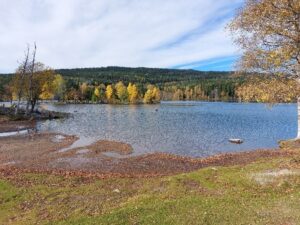
Sognsvann © Friederike Götz
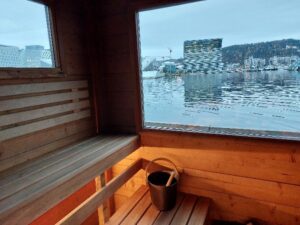
Sauna in the Oslo Fjord © Friederike Götz
Our weekend trip to the Nærøyfjord
One weekend, I went on a trip to the fjord scenery of Norway together with some of my internship colleagues. We rented a car (which was more difficult than expected, as we needed either a credit card or a Norwegian bank account, which neither of us had) and drove almost 8 hours to Voss, a municipality near Bergen. The drive took longer than expected because there was heavy rain that day and several times we came to places where a Norwegian stood next to a car with hazard lights on in the dark in the rain and told us that the road was closed and we had to take another route. In the end, we arrived at our accommodation right on the lake – which was now more or less in the lake, as our basement was flooded. Fortunately, the water had not damaged much and the upper floors were enough for us to sleep. So we were able to enjoy our weekend including an acquaintance with the unpredictable strength of Norwegian nature and a ferry trip on the Nærøyfjord, one of the two UNESCO fjords in Norway. The ferry went from Gudvangen to Flåm, a village famous for its railway, and was pleasantly empty as we were there outside the main season. Although the weather was not the nicest, the view was fantastic and I took many impressive photos that will always remind me of this unique experience.
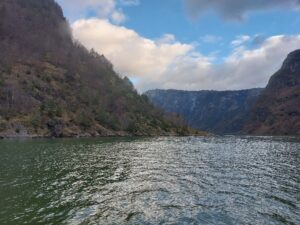
On the ferry in the Nærøyfjord ©Friederike Götz

View of the lake at our accommodation in Voss © Friederike Götz
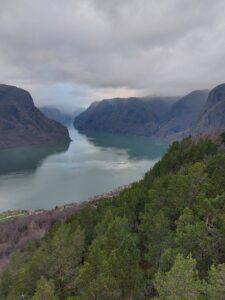
View of the Nærøyfjord from Stegastein viewpoint © Friederike Götz
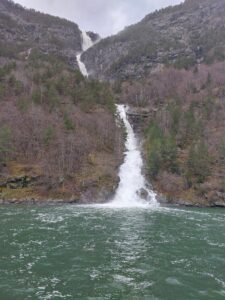
Waterfall in Nærøyfjord © Friederike Götz
My internship in Norway at Kverneland Energi
- M.Sc. Mechanical Engineering
- Norway, Kvernaland (living in Stavanger)
- Kverneland Energi
- 04.04.2022 – 30.06.2022
On April 1st I arrived in Norway and my first day of work was the 4th of April.
Kverneland Energi is a company that installs PV-systems, plans and installs battery systems and develops the software for projects that either just rely on generators and batteries or additionally use PV panels. My entry in the company started with learning the basic installation process of PV- systems on three different kinds of roofs:
1.flat roofs, which are mostly seen in industry applications
2.steel roofs often used in agriculture; a very interesting sector with wide availability of space for PV- systems and interest in the investment mostly to self-sustain the farmland; and
3. the classic gable roof with tiles, which can either have a hook-system to install the panels ‘on top’ of the tiles or alternatively the pricier option of an embedded PV-system
I worked for the first half of my three months stay in the installing sector of the company and got to know the difficulties and intricacies, which each different kind of project presents. The weather in April in Norway is tough
to predict and I experienced pretty much every time of the season in those 6 weeks –
starting with snow in week 1 of work and ending with summer like conditions in May, the part that needs most getting used to is the 8-hour work in constant rain. Stavanger is notorious for being city being blessed with rain, but thanks to the golf stream the extreme temperature drops are not too common there and therefor snow is rare. A one-hour drive to Sirdal is not only one of the most impressive road trips I have ever taken, it also completely changes the scenery and climate – presenting itself with at least half a meter of snow in the around easter.
That being said, I got quite lucky, and we mostly worked in sunny weather conditions – with wind presenting the biggest challenge. Carrying and installing the panels in these conditions can be very tricky and presents the engineers with the challenge of providing a system that is able to sustain all kinds of weather challenges on a constant basis.
After 6 weeks outside I joined the software programmers in the office space in Kvernaland, around 30minutes outside of Stavanger. There I worked closely with Andreas, an electrical engineer on a project which runs off grid. The cabins located in ‘Stranddalen’ are about a 1.5h hike away from the next closest village and require an energy system without a grid connection – relying on a generator and sunlight.
With a combination of a large generator, solar panels, and a battery system the cabins can self- sustain for the
3-4 month opening period, starting
in the middle of June. During the winter, the batteries are discharged and must handle temperatures around -10°C over weeks, the panels need to sustain meters of snow pressing down on them. All these extreme weather conditions make this project incredibly exciting!
This project started as the bachelor thesis for Andreas, and my job for most of my time in the office was to program a updated plan to improve the efficiency of when the generator needs to be active, and when the PV-power and battery system can supply the cabins without the use of fuel. Challenging in that was the variation in consume, produced PV current and request of the customer to not run the generator from 9pm to 8am. The battery system is the most important thing to avoid running the generator too often and use unnecessary fuel. Working with data collected over the last 2 years and realising patterns about consume and production, Andreas, Sjur and I implemented the new code created in TIA portal by visiting the cabin and accessing the electric system at the cabins.
Before the visitors and personal come to the cabin, the new system needed to be implemented. A 2-hour hike with increasingly more snow on the path the further we went up the mountain in the middle of June was one of my most surreal
experiences and showed me (once again) the stunning beauty of Norway! And the 2-day stay with my two Norwegian co-workers that I had to this point known for only a few weeks was amazing and I always felt very welcome – and that was the case pretty much everywhere I went in Norway.
Without ERASMUS, this trip would have not been possible for me – it was tough to find a place to live for short term rent that was also affordable. Same goes for every day needs like groceries or public transport tickets – everything is more expensive here, without exception. If you plan on having a less stressful time in Norway, then a good approach would definitely be to make a spending plan before arriving. And if you have a car, I would very much advise you to drive it up to Norway if you want to see much of the country as public transport is definitely improvable to say the least. My 17-hour trip from Aachen to Stavanger by car was exhausting but the best decision I made coming up here – though not very sustainable I have to admit. If you ever get the chance to travel to Norway: take it, it’s absolutely worth it!
My experiences in Trondheim, Norway
- Business Administration and Engineering Materials and Process Engineering, M. Sc.
- Trondheim, Norway
- NTNU Trondheim
- 01.04.2022 – 31.05.2022
My experiences:
I am solely responsible for the content of this report.
During my master thesis which I am writing in collaboration with the NTNU in Trondheim and RWTH in Aachen I spent two months in Trondheim.
Preparation
Since I was already in Trondheim the semester before as an exchange student, I was quite familiar with the city, university as well as with the application procedure. During my exchange semester I attended the course MFA I (Material Flow Analysis) with Prof. Müller and decided to write the upcoming master thesis together with him and the RWTH.
After gathering some information, the application was very easy and quick. The next step was then the application/registration at the NTNU to get the student rights etc. and to be also able to apply for student accommodation through SIT (the organisation which provide the accommodations and other things in Trondheim). I received the confirmation of both in time so I could plan all the rest.
Office routine
During the two months I felt very welcome at the department and was able to work in the study room with all the other students writing their master thesis. This was a good way to get to know them and to see on which topics the other students and researchers in the group are working. My weekly meetings with my supervisors could now also take place in person, which was very helpful for the working progress. I could also participate in the regular group meetings of the research group where the researchers of the group are presenting their work.
Leisure
Because I still knew some people from my exchange semester, it was very easy to find a lot of activities for the time besides the thesis. On weekends we went on a lot of cabin trips in the surrounding area, spent evenings on the fjord to watch the sunset, went bouldering or in bars. Trondheim has especially for students a lot to offer. A very nice coincidence was that the 17th of May, which is the national holiday in Norway, was in my time in Trondheim. This was a perfect opportunity to get to know the Norwegian culture, starting with a brunch and parades in the city.
My research stay in Oslo
- Chemistry M.Sc.
- Norway, Oslo
- Universitetet i Oslo
- 12.09.21-12.03.2022
Over the course of my studies, played with the idea of doing an exchange, though, for various reasons, I never went through with it. With the end of my master’s degree approaching, I decided to make use of this last chance and to complete my master thesis during a research stay at a university in another country. The planning for this started in May 2021, at the height of the second COVID wave. This narrowed my choice of countries down to all of Scandinavia, since the situation there was somewhat calm, though at this point the borders were still closed, and it wasn’t clear when they would open again. Nonetheless, I started planning.
After looking at all the major universities in Scandinavia, I found that UiO (Universitetet i Oslo) and UiB (Universitetet i Bergen) did interesting research that aligned well with my qualifications, but also with skills that I still wanted to acquire or improve. After contacting a professor at each university by e‑mail, Prof. Tilset from UiO was able to accommodate me for an interesting project in the desired timeframe.
At first, I tried to find housing privately on finn.no (Norway’s equivalent to eBay), but as a foreigner, a male, and someone staying for a mere few months, it is very difficult to find a place in shared accommodation. Thankfully, the Department of Chemistry offered to apply for researcher housing for me. Most of the student housing in Oslo is run by SiO (Studentsamskipnaden i Oslo og Akershus), a student welfare organization. Their housing is well-maintained and somewhat modern, though as a researcher you pay 20% more rent than students. Electricity, water, and internet access are included in this. This is still cheaper than the very expensive private housing in Oslo. I paid 4800 NOK in rent for a room with a shared kitchen (6 people), which is about 480 €. Having to pay more as a researcher was a recurring theme for my stay in Oslo, since I mostly didn’t get student discounts. As another bonus, you get housed with other students of Oslo’s universities, so you have ample opportunities to make friends. On the day of your arrival, it might make sense to make use of the hourly Ikea shuttles, which take people from the city centre to one of two Ikea markets (free of charge). This lets you buy the necessities for your room/apartment conveniently. The location and departure schedule can be found on Google Maps.
When staying in Norway for more than 9 weeks, it is mandatory to register with the police, where (if you’re an Erasmus intern as opposed to an Erasmus student) you have to document that you have enough money to support yourself (e.g. savings, the equivalent of 180.000 NOK per year, or less if you’re staying for a shorter time), a valid national identity card/passport and private health insurance. I did not know of the latter, but the worker at the police was kind enough to register
me as a student when I showed her the signed agreement of the three parties and proof that I received funding from Erasmus (in my case a bank statement).
Oslo has good public transportation (Metro, Tram, Busses, and Boats), but the normal monthly ticket (800 NOK) unfortunately is constrained to the city limits, which nonetheless should cover most of your trips. Extensions can be bought in the public transportation company’s app, Ruter.
Since you will be paying in NOK, it also makes sense to open an account with a bank that charges no fees for paying in foreign currency, e.g., DKB. Credit cards are universally accepted, so there is little reason to carry cash.
For leisure activities, the Norwegians are generally very fond of the outdoors, so popular activities are ice skating, skiing, or hiking, sometimes combined with a picknick. Outdoor equipment can be borrowed free of charge at one of the many Bua’s (a non-profit organization) around Oslo. During the winter, many people sit around campfires around lake Songsvann or atop the Vettakollen mountain. These are also nice places to try and get a glimpse of the northern lights. The Norwegian trekking association (DNT) organizes trips (e.g. mushroom picking or hiking) and rents out cabins for cheap. If going out to eat is more your thing, Oslo Street Food is worth recommending. It’s a cozy food court with lots of selection, but don’t expect to be served large portions.
Here it should be mentioned that the selection of vegetarian food is more limited in Norway than in Germany, and vegan food even more so. If you’re a big partygoer, beware: Alcoholic beverages are very expensive in Norway, and only sold until 8 pm. Anything over 4.7% is only sold in the state-run Vinmonopolet shops. If you’re more culturally inclined Oslo’s many museums might be of interest.
Because I did not need to attend any courses, I could focus solely on my research and enjoyed lots of autonomy. The university is generally well equipped. I had my own lab bench and fume hood in a large lab with 5 other researchers (Bachelor/master students, PhDs, and a post-doc), as well as a desk in a shared office. Approximately half of the researchers were Norwegian, the other half from all over Europe. The direction and progress of my research was evaluated in weekly talks with my supervising Professor. In addition to that, there were weekly group meetings and biweekly section meetings, were people would present their research and the rest would give feedback/ask questions. The working climate was very pleasant, and I spent hours talking to fellow researchers about their or my research.
In conclusion, my time in Oslo was a great experience, both professionally and personally. I got to do research abroad, acquired new skills, and refined those I already had. I met lots of new people and made friends and memories. While the cost of living is certainly high in Oslo and coming to Norway as an intern is associated with some challenges, the experience was certainly worth it.
