
Kategorie: ‘Other’
Internship in the Republic of Northmacedonia
- Practical Year in Medicine
- Republic of Northmacedonia, Skopje
- University Clinic for Dermatovenerology
- 01/2023 – 03/2023
My experiences:
Preparation: To organize this internship was fairly easy. The person responsible at the university is very responsive and very organized. Within two days, I had the acceptance from the department of dermatology. Once you are accepted, start preparing for the visa. It’s nearly impossible to reach the embassy in Berlin via phone and I recommend to prepare all documents and then go there directly. They will then tell you if something is missing. Just a hint here: The criminal record needs to have an apostille and you will need to translate all documents into Macedonian. If you translate it from English, you can reach out to official translators in Macedonia. They are very reliable and work quickly.
To bring: You should bring scrubs, a coat and a stethoscope, etc. As a nice gesture, do not forget to bring some souvenirs from your city.
Language: I was amazed by the advanced level of English the general population has. As they do not dub their movies, nearly everybody understands English and speaks it. However, I recommend making an effort to learn Macedonian. A great book to learn it is ‘Macedonian: A Course for Beginning and Intermediate Students’ by Christina E. Kramer and Liljana Mitkovska.
Health: While technically the European insurance card is valid, I recommend getting a private health insurance. Prices for consultancies are affordable and you will not wait longer than a few days to see a specialist. I went to the dentist here and I got an appointment within one day. The quality of care in the private sector is very good.
Safety: Macedonia and Skopje are very safe. Even when walking through the city at night alone, I never felt unsafe.
Money: In most places you can pay cash or by card. It’s good to always have some additional cash with you as some places – especially in the rural areas – do not accept card payment. If you have an apobank credit card, use the atms from Hallbank. They do not charge any fee.
Shopping: The cost of food in the supermarkets is comparable to Germany. However, going out to eat is considerably cheaper and activities such as going to the ballet/opera cost around 5€.
Transportation: Skopje has very cute double decker busses which are well connected. However, as I lived close to the hospital, I walked there. As the city center is quite small, most of the major sights and places are in walking distance. If you plan to travel within Macedonia, check out the bus companies at the bus station. At very reasonable prices you can go nearly everywhere. Biserprom is a bus company that offers weekend or single day travels. Check out their Facebook page. I went to Mavrovo (a great ski resort) and back for 5€.
Communication: As Northern Macedonia is not part of the EU-roaming packages, you will need to buy a separate SIM card. I recommend choosing A1, which has monthly packages for 300MKD (approx. 5€) 20GB. The internet connection with the mobile phone is super stable and coverage is great. Even when hiking, I never lost network.
Accommodation: To find a flat, have a look at AirBnB, Facebook (group: Skopje expats) and reklama5. In general, prices for a flat should be around 200-300€ – you can of course find cheaper rooms in the outskirts. I lived in Kisela Voda, which was a great and quiet neighbourhood.
Travel and arrival: There are numerous air- and buslines that go to Skopje. I travelled with bus (32h drive) for approximately 100€. While they do take breaks every 1-2hours, it is not the most comfortable way to travel. If you decide to go by plane, you can take a taxi or a bus which runs every 3-4h to the city.
Work routine: The mornings start with a short round of patient visits and then a morning meeting with all staff at 08:00. Afterwards, you continue to see the patients together with the specialists. On Wednesdays, all staff does a round together to see all patients. After the morning round, you can choose which specialist you want to join. Most doctors are happy to explain everything to you while they treat the patients, which is very helpful to understand the conditions of each patient.
Free time: Skopje is a great place to be in the nature and hike. In walking distance from Skopje center, there is Vodno mountain which offers a great view of the city. Near Skopje, there is the Matka canyon which features underwater caves whose depths haven’t yet been explored fully. The Vrelo cave is with its explored 240m already one of the deepest caves in Europe and the world. Another place worth an excursion is Ohrid, a beautiful city three hours south of Skopje. It is bordering the lake Ohrid, one of the oldest lakes in the world. In Ohrid, there were 365 churches/chapels – one for each day of the year. While not all still exist, there is a significant amount of them one can explore. If you are less into nature, have a look at the numerous great coffee bars Skopje offers. At nearly any time, you can see people chatting and drinking coffee there. The old bazar is also a must see.
My practical year in St. Johann in Tirol, Austria
- Medicine
- Austria, St. Johann in Tirol
- Bezirkskrankenhaus St. Johann in Tirol, department of “Allgemein- und Viszeralchirurgie”
- 11/2022 – 01/2023
Preparation
I applied around ten months before the start of the Practical Year (called Praktisches Jahr (PJ) in Germany or Klinisch Praktisches Jahr (KPJ) in Austria). However, most places at the hospital “Bezirkskrankenhaus St. Johann in Tirol” are already taken one and a half to two years in advance, so it makes sense to call first and ask if there are still places available. The contact person is the “Sekretariat Ärztliche Direktion”, whose contact details can be found on the hospital’s website. They will also tell you which documents you need for the application. The hospital is a teaching hospital of the Universities of Innsbruck and Vienna. I would recommend contacting Ms. Lemos, the coordinator for study abroad of the medical faculty of the RWTH Aachen University, in time for necessary formalities.
Accommodation
There is a house right next to the hospital where students who are interns at the hospital can stay for free. Each student has their own room and bathroom. The kitchen is shared and is a great meeting place for communal meals and game nights. You also get free breakfast, lunch, and dinner from the hospital. However, the number of rooms is limited, so you should register for this in time. Since there wasn’t a room available at first, I lived in an apartment in the neighbouring town for the first two weeks. Then I was able to move into the student house for the remaining time. I would recommend checking regularly with the secretary’s office, as there are often vacancies in the house at short notice. I found support in finding a private apartment at the secretary of the hospital and the tourism association (Tourismusverband St. Johann in Tirol), each of which sent me a list of contact details of private landlords via e-mail.
Traineeship
On the first day of my internship, I had some organisational tasks to do: I reported to the secretary’s office, received work clothes, a staff ID card, and keys. Then I introduced myself to the surgical department. The working day began daily at 7.15 a.m. with the morning meeting. Afterwards, we medical students took some blood samples on the ward or assisted in the operating theatre. The rest of the time we accompanied the doctors in the surgical outpatient department. The day ended around 4 pm after the X-ray discussion and the ward rounds – on Fridays, usually a little earlier. As a medical student at the hospital in St. Johann, you do two night shifts a month, one during the week from 4 pm until the next morning and one on the weekend. The tasks include taking blood samples, setting up intravenous lines and assisting in the operating theatre if necessary or helping in the emergency room. I would recommend rotating also to orthopaedics/trauma surgery as part of the surgical tertial if possible.
Free time
The region around St. Johann in Tirol is situated in the middle of the mountains and offers many great leisure opportunities. There are many ski resorts nearby, e.g. St. Johann itself, Kitzbühel, Saalbach/Hinterglemm or Ellmau/Scheffau. In some of them you even get a discount with your employee ID card! In other seasons, of course, there are also wonderful hikes to be done. The cities of Kitzbühel, Innsbruck and Salzburg are also not far away. In December, the Kitzbühel Christmas Market is definitely worth a visit!
Conclusion
I really enjoyed my time in St. Johann in Tirol and can recommend a PJ tertial in this great area. I made many new friends, and we made great memories together in the hospital and during our weekends in the mountains.
Getting to know a different culture
- Mechanical Engineering B.Sc.
- France, Signy L’Abbaye
- Beuret Sarl
- 09/22 – 12/22
My internship in France
The company I worked for produces agricultural equipment and steel structures for buildings. Since the company moved to a new location recently, they needed new custom equipment like tool cart for storing and moving heavy tools. I spent the majority of my time developing, designing in the office and manufacturing this equipment in the factory. Having the responsibility for those projects and completing them was a truly rewarding experience.
Even though I did not work on the division of the company that was responsible for the buildings they let me go on the respective construction sites a few times during my stay. Although this was not at all part of my internship, I still enjoyed discovering the big machines and assembly techniques they used to join the massive components that were previously prepared in the factory.
Working in a small company (about 10 persons in total) helped me to get to know all the people very quickly. I had a great relationship with both the employees and the supervisors from the beginning on which made my time in the company really enjoyable.
I worked a total of 40 hours a week which is not necessarily typical in France. Many people only work 35 hours. This makes room for other activities after work. Also, the meals have a much greater importance than in other European countries. Lots of companies have 60 to 90-minute lunch breaks and it is common for grocery stores and other shops to close during midday. But many stores make up for this by opening their doors on Sunday morning.
Luckily, on Fridays I only worked till 12 pm which made it possible to plan longer activities for the weekend. I tried to discover as much as possible of the “Champagne” region. It’s especially known for its production of champagne and its vineyards.
On another occasion I had the opportunity to travel to the beaches of the Normandy and admire the breath-taking landscape. These places are not only beautiful but also have an undeniably interesting historic relevance.
Travelling to these different destinations by train is difficult and takes a lot of time. In addition, the company I worked for was situated in a very rural area. So, having a car was a necessity in this region of the country.
Something you need to get used to when you live in France are long and late dinners. Most of the time, they start with the well-known “apéro” where you have a few drinks and snacks before beginning to eat your meal. I really enjoyed those convivial evenings. I also observed that drinking wine at dinner was a lot more common than in Germany. Even a lot of young people enjoy drinking a glass of wine instead of beer. In general, the locals are proud of their local wine and especially champagne.
Helpful information
Good news is my phone worked without any issue thanks to EU-Roaming. On the other hand, German mobile network operators have put in place a limit of months that you can spend abroad. Exceeding this time limit will result in them charging you extra roaming fees. Luckily, many French carriers provide very generous offers for the first year of contract. Combined with a pricing that is generally much lower than in Germany, getting a mobile plan with a lot or even unlimited data becomes very affordable. Your mobile plan can even replace Wi-Fi. So, if you plan on staying more than a few months in France, I would definitely recommend getting a French mobile plan.
Same thing goes for your bank account and credit card. You should check with your bank if the card you plan on using works abroad. Opening a bank account was not necessary for me but it made withdrawing money free of charge and receiving my salary was also easier this way.
Keeping in mind that finding a fitting internship and going through the application process would take a bit longer than in my home country, I started to plan my stay more than 6 months ahead. This gave me enough time to prepare everything properly and I would recommend this to anyone who wants to go abroad. All in all, my internship abroad was a great experience for me. Getting to know a different culture and improving my language skills while completing a mandatory part of my curriculum was amazing and I would recommend it to anyone who has the opportunity to do so.
My internship in Bilbao
- Business Administration and Engineering M.Sc. Mechanical Engineering
- Spain, Bilbao
- FEV Iberia SI
- 10.10.2022-15.01.2023
Preparation:
When it comes to preparing for a stay in Bilbao, the most important thing is housing. In general, finding a place to live in Bilbao is not as stressful as in other cities. The best place to look for housing is “idealista”, a Spanish online real-estate marketplace. Prices obviously differ, but finding adequate housing for around 500 Euro/month is possible. Especially, when you can communicate in Spanish and also stay for at least half a year. Also, there are Erasmus Telegram and Whatsapp groups (you can find them on Instagram or in the Internet) where rooms are offered as well. Besides to look for housing, this is also a great way to make first contacts in the city. Another important preparation would be to look for health insurance. I had the luck that it was organized by the company.
Finding an internship:
In my case, I was a working student in the Aachen Office of the company I then worked for in Bilbao. Generally, going for an international company is the easiest way to find an internship abroad and that’s also how most people I talked to did it. Especially, when you are not fluent in Spanish, a regular local company will be tough to convince to take you.
Culture:
Most people have been to parts of Spain before, so I guess a Culture shock is not to be expected in
that case. However, Bilbao is part of the former Basque-county. Even if it is technically Spain, the people are often quite proud of their heritage. Some might take it as an insult, if you call them Spaniards. Additionally, the Basque language is very prominent. You will hear it on the streets and read it a lot on signs. It is very different from Spanish, so don’t be fooled thinking it is just some form of dialect you might be able to understand! All in all I must say, people were very welcoming and most of the time happy to help and communicate, even if there isn’t actually a common language between you. The level of English capabilities is very low in that area, so basics in Spanish or Basque can be very helpful.
Day to day life:
Coming from the culture, food plays a very significant role there. Pintxos (A slice of bread with ANY savory toping you can think of) might be the most prominent one. You can take them for lunch or in the evening with some drinks. Since the city is next to the ocean, fish and other seafoods are integrated in a lot of dishes. If you are a vegetarian or a vegan, it might be hard for you. In more traditional restaurants the vegetarian dish is just a salad or something along that line, so you might want to go to more modern places.
When it comes to going out in the night, Bilbao has a lot to offer. Especially in the casco Viejo (old town) the bar density is very high. But also throughout other parts of the city, you will always find a nice place to grab a beer or a Kalimotxo (popular Basque drink, red wine with cola) and some Pintxos. The club landscape is definitely more restricted. For most clubs, you have to love reggeaton, since it will be played the whole night. But there are also some clubs, where the music choices are more diverse (strong recommend for “Sala Sonora” for Saturdays).
Public transport is ridiculously cheap and easy in Bilbao. You go to any bigger metro station and buy a “Barik Card”, on which you then can load money. From then on, you just touch-and-go for trains, buses and the metro for prices mostly below 50 cents per ride. The metro also goes all the way to the ocean. Plentzia and Sopella are the beaches reachable by metro I recommend the most. If you want to explore the area, for hikes or to visit other towns nearby, going by bus (Asta or bizkaibus) is a very good option. Most beautiful places I have seen are: San Sebastian, Gangekogorta and the Urdaibai area.
When it comes to work life, in my case it was very similar to my experiences in German companies. Similar working hours, with maybe a longer lunch break and in my case an amazing office climate. My co-workers were always happy to help with tasks or problems at work, but also with recommendations what to do in the area on weekends or which restaurant to go to.
My experiences in the Netherlands
- Biomedical Engineering M.Sc.
- Netherlands, Utrecht
- UMC Utrecht
- 01.06.2022 – 16.11.2022
Preparation:
To give myself some headroom to deal with the difficult housing market, I started looking for positions about nine months before the planned starting date. By the time I had found a position it was just four months to the starting date so that also had some implications on the available options in the housing market. A lot of general information pages about going abroad in the Netherlands recommend housing agencies like SSH to find student or some form of affordable housing. However, some of these agencies rely on a long waiting list, where it is more likely to get a housing offer the longer you are on the list. So, if you are running low on time, you can probably skip these options and look for alternatives, which saves you money in the process. This is another peculiarity of the Dutch housing market. While the German housing market is fairly accessible through online portals where you can see most of the available housing for free, the Dutch housing market is essentially locked behind a paywall, where most services require a subscription to contact any of the landlords. I found housing through the university hospital, which was by far the cheapest option compared to the private market. I was also required to make an appointment with the municipality for the registration purpose well in advance. I was able to get an appointment about four weeks away from the date I was looking on.
Commuting:
The Dutch system called OV-chipkaart makes commuting easy. It is essentially a prepaid (or bank account linked) public transport ticket which allows you to take every bus or train by simply checking in at the station or in the bus when you get on and checking out when you leave. It may be a little intimidating at first because you are always second guessing yourself if you have checked out correctly, but you can also register your chipkaart in the NS (Nederlandse Spoorwegen) App where you can check your latest chipcard activities. You can either order a personalized (bank account linked) card online, which takes about two weeks, or get a prepaid one at your local supermarket like Albert Heijn or Jumbo. I took the prepaid option which was still very comfortable because recharging stations are readily available at all train or bus stations and even some other locations like supermarkets. However, commuting by bus may become a noticeable financial burden because every trip you take has a flat base fee plus a per kilometre fee. Especially the base fee becomes very noticeable on short distances common inside the city.
With all of that said though, the obvious choice for commuting in the Netherlands is naturally the bike. Especially in Utrecht the bike infrastructure is exceptional. There are well maintained bike paths and bike storage everywhere which makes commuting by bike a treat. I took my bike from Aachen to Utrecht by train which is easy via the NS intercities.
Every-day life/internship:
Life in the Netherlands isn’t really all that different from life in Germany. Supermarket prices are a bit more expensive in some categories but are generally comparable to the ones you would fine here. This also applies to your average take out service, where a decent portion of fries will set you back about 3 € and a high-quality pizza is about 10 €. Payment services are also a non-issue in the Netherlands if you have a German debit card. There are very few places, if any, where you will encounter the need for cash because everything is paid by card, and I haven’t had any issues with my debit card (no extra fees or anything).
The Dutch working culture is also kind of similar but one thing I have encountered during my stay is that they put less emphasize on the lunch break. The lunch breaks were generally quite short (often just shy of 30 minutes) and primarily focused on food consumption. However, this may be attributed to the group I was working in. My internship was in the neuro engineering department of the Medical Centre Utrecht, which was a very international and highly goal oriented, so I spent a lot of time working.
Utrecht as a city also offers great recreational opportunities in forms of parks and proximity to farms around the campus. I regularly took strolls along the fields after work. If you take a bike, there are also a lot of historical landmarks within reach, including a lot of different forts and castles.
Conclusion:
While the housing situation and cost of living may be a little overwhelming in the beginning, the Dutch culture is very approachable and welcoming. The country offers a great experience in terms of travel, be it by bike or by public transport, which was a welcome change from the car centrist life in Germany. The university hospital in Utrecht is very well equipped and offers knowledge in a wide range of topics.
Toledo- an old city with a lot of Spanish flair
- Biology M.Sc.
- Spain, Toledo
- Hospital Nacional de Paraplejicos
- 04.05.2022-30.09.2022
My name is Anna, and I have been studying at the “Hospital Nacional de Paraplejicos” in Toledo from May to October 2022. I study Biology in my Masters. In the following, I will try to share knowledge with you that will help you to make the best out of your stay.
The preparation for my internship focused on transport, insurance, and housing. For my research internship abroad, I travelled to Toledo by plane. I arrived at the airport in Madrid and travelled from there to Toledo by train. If you do not want to go by plane, you can also go by railway. This takes a little bit longer, but you can combine your travel with some stopovers in other beautiful cities. Further you save some CO2 and secure the additional Erasmus funding for a green travel back home.
The health insurance is very simple. If you didn’t already have one included, you can ask your insurance to provide you with a European health insurance card. Keep in mind that most insurances do not cover rescue or repatriation in case something goes wrong on a hiking trip for example. You should ask your insurance about that.
I started to look for a flat or a room in Toledo approx. one month in advance. I made some visiting appointments for the first few days. During this time, I was living in a guest room in the professor’s house. The apartment search turned out to be very difficult. I tried to find a flat with the website “Idealista”. Many accounts didn’t even answer or other flats where small or dubious. Also, the language barrier was a big problem, due to the reason that the most landlords did not speak English. I would recommend all students doing an internship in Spain, to practice some Spanish before your internship abroad. Without the help of my work mates most of the viewing appointments were not able. Further I would recommend structuring your profile on those websites so personal as possible. If you apply for an apartment, you should always bring some personal stuff inside the texts and maybe take up some points of their advertisement.
After visiting some flats without any success, one of my workmates had the idea to look for a room in a student’s residence. I found a place in the “Residence María Immaculada Toledo”. Here I lived in a single room in the casco of Toledo. The rent for one month was 520 euros including breakfast, lunch, and dinner. This room was only available for 1 month, so I had to look for another flat in the meantime. Happily, I found my perfect flat quickly. It was a shared flat with three other Spanish girls in the age between 25-30. All three of them were as well working in the hospital. The flat was just perfect, with a large living room, a large kitchen, and a swimming pool. It was also near to the hospital, so I could walk every day by foot to the work. The rent here was 250 euros excluding extra costs like water and light.
My first impression of Toledo was impressive. It is an old city with a lot of Spanish flair. Exactly what I had expected from Spain. I applied for a position in the “Hospital nacional de paraplejicos”, to do my practical course of my master thesis there. The hospital and the investigation have their focus on spinal cord injuries. The hospital is very new and modern, and my work collogues were helpful and nice from the first moment on. I really enjoyed the work in the hospital. The willing to help was so large from all my work mates, and they integrated me into their team very quickly. I learned a lot of new techniques important for my further working live. I was working on my own project. Although the working language in the laboratory was English, it turned out to be a little bit tricky to communicate. The English knowledge of most of my collogues was rather bad. On the other hand, my Spanish knowledge was not the best. So I decided to learn a lot of Spanish int the next few weeks. The understanding was getting better from day to day. As well in English, but also in Spanish. Quickly I was able to follow conversations in Spanish and to talk some basic sentences.
With the girls of my flat I made friends quickly. They took me on hiking tours, we all signed in for the gym and they told me how to play padel tennis, a very popular sport in Spain. On the weekends we normally went out together and they introduced me to their friends. They took me to cultural events in Toledo and told me which places are worth to visit. Another positive point is the close distance to Madrid. It is only 30 minutes by train, so you can also explore the capital of Spain on the weekends.
Going to Toledo was one of the best decisions of my life. The “Hospital nacional de paraplejicos” is a great hospital with nice work mates and a great investigation department. On top, Toledo is a nice, typical Spanish city with endless opportunities and a close distance to Madrid. I hope that my short report gave you some insights into these opportunities.
My practical year in France
- Staatsexamen, Medizin
- Rouen, France
- Hôpital Charles-Nicolle de Rouen
- May 2022 – September 2022
Preparation
The preparation began about a year before I started my Practical year (Praktisches Jahr- PJ). For the registration and application, I contacted Ms. Watteel directly, who is responsible for Erasmus stays at Université de Rouen Normandie. She was my contact person during the entire Erasmus stay and took care of all formal requirements and certificates in a timely manner.
Housing
Accommodation can be found at leboncoin.fr (something like Ebay in Germany) or Facebook. There is also the possibility to apply for student residences, but I did not do this. Furthermore, there are many real estate companies in Rouen that rent both furnished and unfurnished apartments. It should be noted that if the apartment is rented through a company, a fee of approximately one month’s rent must be paid. For students, the right side of the city is warmly recommended, because most of the activities and parties are on this side of the city. There are good bus connections to other parts of the city, but they are very limited at night. The university hospital is located almost in the city center and is easily accessible by public transportation.
Job and everyday life
I completed a PJ tertial in the clinic for general surgery (chirurgie digestive). There I was in the OR every day and was allowed to assist most of the time, be it directly on the patient or administering the instruments. There were many opportunities for me to actively participate. I found it very good that I was allowed to sew up, that I could participate in organ donations, and that I was also able to perform some tasks beyond the student tasks. A normal day started at 7:30 a.m. and ended between 4:00 p.m. and 6:30 p.m. The visceral surgery team was very nice and had a lot of patience, especially when I occasionally didn’t understand things because of the language barrier. There were some doctors who also explained things in English, although this is not the rule in France.
For the internship, you get a reimbursement of about 250€ per month, but you must check with the HR department often and have a French bank account. All students who are currently doing their internship in a surgical department share the 24 hour duties among themselves. These services are additionally paid but are not obligatory for exchange students. During the night duty you have to do instrumentation and assist in the OR. You get your own room with your own DECT phone. If you are lucky and there are no emergencies, you may (and should!) sleep.
Leisure
I was very fortunate to have a large circle of friends in Rouen, which made the stay overall very social and gave a different perspective to the busy PJ. It is very common to end the evening in a bar or café, although it must be said that due to the early working hours this was often not possible. Rouen is a student city and there is always something going on. In summer there are concerts every Thursday, there is the daily Cathederal de Lumiere, which was exciting every time again. It is a beautiful city from the Middle Ages, so there is a lot of history to see. The numerous museums are free until the age of 26. The surrounding cities like Paris, Le Havre, Étretat or Vernon are very worth seeing and easy to reach by train.
Conclusion
Rouen should and can definitely be recommended for tourism as well as for the PJ. I learned a lot there, was able to do a lot of practical work and strengthened many social skills in the professional setting. The beginning of the PJ was very exhausting, because a lot of things happened very quickly in the hospital and the medical terminology is clearly different, plus it contains many abbreviations. It was a great opportunity to deepen my French and to get an insight into general surgery. Four months were enough to settle in well and to get a little insight into the rest of Normandy.
A special experience in Cyprus
- Medicine
- Larnaca & Nicosia, Cyprus
- Hospital
- 02.03.-01.05.2022
Good food, friendly people, and lots of sun! That’s the best description I can give for this beautiful island! The people here are extremely friendly and helpful. It is easy to communicate since most of them can speak English which I think is really important for tourists and exchange students. The application for the internship can be made through the website of the University of Cyprus or via email and is a very simple procedure. Just be sure to check out the deadlines and be fast because there are only few places, and they are filled quickly!
Flight tickets can be expensive but there is a direct flight from Cologne to Paphos with good deals. If you book them in advance, you could be lucky! There is another airport in Larnaca where other airlines like Aegean, Eurowings, Lufthansa, Austrian airlines and many more operate. Generally, there are a lot of options especially if you do your research on time.
Nicosia is the capital of Cyprus and where the University and most of the students are. I would therefore recommend that you find a place to stay there. It is much cheaper if you have a roommate, otherwise rent is around 500 euro. Airbnb is also a good option if you are staying just for a couple of months. A telephone number is really easy to acquire. You just go to a nearby kiosk, buy a number and then top it up! One thing I hated about Cyprus is transportation. There are very few bus lines but at least they are on time. You can also get a taxi but that is of course more expensive. To be fair though, Cyprus is a small island, and all the important places are nearby, so you could always rent a bike or a scooter, which is also fun!
The University itself lacks a bit in organization but if you are motivated you will find your way and can learn a lot! It sometimes takes a while for the staff responsible for Erasmus students to answer to your emails but do not hesitate to call them; they are very friendly and helpful. Additionally, a mentor will be assigned to you, with whom you can set goals and discuss your progress. The students are also friendly and helpful if you have any trouble with classes or administrative work.
In Germany the last year of medicine is a practical year, in which you can visit various subjects and hospitals to gain more practical experience. It is divided into three parts of four months. Therefore I chose to do the first half of the second part in Cyprus, during spring time when the weather is just perfect- not too cold, not too hot. My day usually started around 8:00 in the morning. We visited the patients and reported their progress back to the attendings. During the day I was free to decide, whether I wanted to stay in the ward or go to the policlinic. The doctors were all extremely nice and ready to answer all my questions. The working environment was very friendly and calm. Mondays through Wednesdays we had lessons with a doctor, which was good revision for me. Around 13:00 I was relieved of my duties, so I had the rest of the day off for fun activities!
Cyprus as you know has great weather so you can undertake lots of activities outdoors, like football, skateboarding, watersports, swimming, hiking, minigolf etc. There are lots of parks for picnics or an afternoon walk with some friends. And for those who prefer staying inside the island will not disappoint you!
As I’ve mentioned before the food is amazing! You will find all sorts of cuisines around the island! You can enjoy the best brunch at “Edem’s Yard”, the most delicious pasta at “Rokoko”, the juiciest burgers at “San Pedro”, great sushi at “Umami Restaurant” and the best traditional meze at “Tamblios Tavern”! On top of that, the nightlife will not disappoint you! Mackenzy Beach is a street full of bars by the beach. They organize lots of different events where you can dance to great music and enjoy all kinds of cocktails throughout the year, not just during the summer months! Mackenzy Beach is in Larnaca, which is only 30 minutes away form Nicosia. There is also the famous Ayia Napa with all the clubs and the wild nightlife for all those who enjoy bar crawling and different types of music.
All in all, it was truly an amazing experience! Not only did I make friends, I also learned to appreciate the country more. I would choose Cyprus again at any time and recommend it. The memories I have made along with the knowledge I have gained were totally worth it! If you ever have the chance to complete a semester abroad, you should definitely take it!
My internship in the hospital Bolzano, Italy
- Medicine, Diploma
- Bolzano, Italy
- Hospital Bozen
- 15.11.2021 – 06.03.2022
In Germany the last year of medicine is a practical year, in which you can visit various subjects and hospitals to gain more practical experience. It is divided into three times four months stays each. For my first two month of this practical year, I chose the hospital Bolzano in South Tyrol, Italy. Since I knew this region already from previous holidays, I thought it would be a nice change after the big exam I had in October.
Application
The application process was very easy via email. You can find all information’s you need on the website of the hospital of Bolzano. Just keep in mind to do it one year ahead of the beginning of the internship. For all other organisational matters (contracts, insurance, etc) a staff member, responsible for us students, helped us continuously. She also supported us regarding application and apartment- hunting.
Apartment
Finding a flat was much more difficult than applying for the internship, as the housing market in Bolzano is very scarce and overpriced. Nevertheless, many students live here, and a solution can always be found. I can recommend to look in:
- Facebook groups ( Bolzano Unibacheca Universitari Affitti / Affitto Camera or Immobilienbörse Bozen Umgebung – Wohnungen PRIVAT (ver)mieten & (ver)kaufen)
- or the site: wg-gesucht.de
- and also on the university site: http://accommodationunibz.blogspot.com/.
I found a nice room in the city center in a shared flat with 5 people, which was really nice to connect immediately. Look for a room next to the city centre, since the outside areas are not that nice in general.
Transport
Bolzano is not very big, so you can easily explore the city by walking. However, the hospital was located a little outside town, so I decided to get a second hand bike. Bolzano is a very bike-friendly city. Dedicated bike lanes make it very pleasant to ride and you feel very safe. Some friends of mine preferred to go by bus and bought a Südtirol-Abo Plus card for 150 Euros, which you can also use as train ticket to Trient or cable cars of the mountains. To discover the surroundings of the city, a car is already an advantage, as you are usually much faster than by bus and can thus get to all the places. When we went skiing, we car-pooled and could go straight to the slopes with our skis in the car. It’s simply easier to move around with a car here. Unfortunately, Bolzano has no car sharing, but a bike sharing in the summer months.
Traineeship
My traineeship began in the middle of November 2021. In the Hospital we usually started at 7.30am with the morning reunion. We discussed the patients and the program for the day. After that we all went to have a coffee break together :D. During the day I was free to decide, whether I wanted to go into the surgery room or in the policlinic. The doctors were all extremely nice and polite. The working environment was very friendly and calm. We should at least stay for 6 hours to also get a free lunch, but it was also no problem if you had to leave earlier or could not come at a certain day. Lunch was rich of different options and there were always three courses—yuuummmy! After a while I definitely felt included in the team and could also relieve the doctors of work. It’s definetly an advantage to speak Italian as well as German. In South Tyrol they speak both German and Italian, but Bolzano is a little more Italian, therefore the working language in the hospital is also predominantly Italian. In the outlying areas of Bolzano people prefer to speak German. Most people however are bilingual, so you can easily get around.
Free time
After work there are a lot of options to spend your free time. The region here is very nice for outdoor activities. The mountains (Dolomites) are incredibly beautiful and in summer you can go hiking, climbing, biking etc and in winter it’s perfect for skiing or Snow hiking.
Since I was there in winter, I mostly went skiing. Obereggen, Seiser Almand Carezza are skiing areas that are approximately half an hour by car away from the city and have very nice slopes. You can also rent a sledge or just go hiking in the snow. You get a reduction on the skipass if you show your clinic employee card.
In March it got warmer and we were able to do some via ferrata and hikes in the surroundings (Eppan, Ritten, Jenesien). On the weekends we also did some city trips to Bologna, Venice, Milan, Verona and Lage Garda, which are all less than 2 hours by car. So, it is perfect to explore the North of Italy.
If you like to stay in town, you can drink coffee or have an Aperitivo (Aperol usually 3,5€) with friends. Expenses are quite cheap for drinking or eating and food here is really good. The weather is also amazing. Here some of my favourite food and drink stops: Bar Osteriada Picchio (book in advance), Al cantuccio (nice pizza), il Corso (nice pizza), Nussbaumer (perfect with parents), Exil Lounge (coffee place). Also I can recommend going to the cinema Film Club Bolzano, they often play movies in original language and the theatre Carambolage, who does most of their performances in German.
Willkommen bei Intern Abroad!
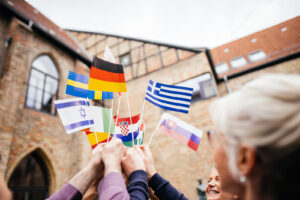
© Oliver Reetz/DAAD
Praktika und Forschungsaufenthalte bei Unternehmen im Ausland stellen eine sinnvolle Kombination von Auslandsaufenthalt und Praxiserfahrung in der Industrie dar, in deren Rahmen Qualifikationen für den späteren Beruf gesammelt werden können.
Studierende, die für diese Zwecke bereits im Ausland waren, stellen hier ihre Erfahrungen vor. Schau dich ruhig um und stöbere durch Berichte aus ganz Europa!
