
Schlagwort: ‘Christchurch’
My Stay in New Zealand as a RWTH Research Ambassador
- PhD candidate for Marketing
- New Zealand, Dunedin and New Zealand, Christchurch
- University of Otago and University of Canterbury
- 02/2026 – 04/2026
Preparation and organization of the stay
My stay in New Zealand grew out of my own research interests. My work focuses on how companies communicate technological novelty, specifically, how linguistic framing shapes the acceptance of novel technologies. One Professor’s research at the University of Otago on market-led innovation and consumer communication was therefore a natural complement to my own work. Once I reached out to her, the collaboration came together quickly, and the planning developed from there.
One point I would emphasize from the beginning: I organized my stay on shorter notice than I would recommend. Ideally, planning should start at least eight months in advance. There is more to coordinate than it may first appear, and one detail that can easily catch people off guard is the structure of the academic year in New Zealand. It runs in the opposite rhythm to the European academic year: the semester begins in February, while the southern hemisphere summer falls in December and January. If the aim is to be integrated into semester activities (which, in my view, is where the real value of a stay like this lies), it is important to time the arrival accordingly and work backwards from local course schedules and invitation deadlines.
For accommodation, I would recommend checking with the university to see if there are student apartments available. Due to my time of arrival, I opted for AirBnB.
First steps after arrival in host country
My stay began in Christchurch, where I visited the University of Canterbury (UC) before continuing to Dunedin. At UC, I met with my supervising professor, whose research on health communication, including how institutions communicated with the public during the Covid-19 pandemic, opened up a rich conversation with direct relevance to my own work on framing and the communication of novelty. It was a thought-provoking start to the trip and a valuable reminder of how questions of framing, communication, and acceptance travel across different domains.
From Christchurch, I made my way to Dunedin and the University of Otago, the oldest university in New Zealand, founded in 1869. The campus reflects this history beautifully: historic buildings, green lawns along the Leith River, and a strong sense of academic tradition. The research group around my supervising professor welcomed me warmly from the very beginning. I was quickly included in departmental life through seminars, group meetings, and informal exchanges, and within the first week I already felt genuinely part of the community. My Airbnb near the beach was the perfect base: compact, cozy, and close to the ocean. I made very good use of that throughout my stay.
Academic/professional experience
The academic core of my time at Otago was built around two formats. First, I co-led workshops and seminars in the course “Market-Led Innovation” at the Otago Business School, in which students develop their own innovation ideas and business models through an iterative, workshop-based process. I contributed content and coaching drawing on the work of the WIN group and the RWTH Entrepreneurship Center, guiding students from early stage idea through market logic and business model development. What struck me throughout was how universal the core tensions of entrepreneurship are and how much context shapes the answers. Woven into the course were industry talks from New Zealand and international companies, among them ZURU, a globally successful consumer goods company that built its reach from New Zealand outward. A compelling illustration that market driven innovation can work from almost anywhere, and an example I’ve already brought back into my own teaching. Second, I delivered a research seminar for staff and postgraduate students, presenting my paper “Framing Novelty in Innovation – Exploring the Role of Linguistic Framing in the Acceptance of Novel Technologies.” This connects directly to what had drawn me to my supervising professor’s work in the first place: we are both interested in how novelty is communicated and received, approaching it from adjacent angles. The discussion that followed was dense and substantive, and the marketing science perspective I took away has fed back directly into my research.
Financing
New Zealand is not a cheap destination. Rent is the largest fixed cost. For a private place, one should expect to pay around NZD 1,500–2,000 per month, depending on location and
standard. Student accommodation may be cheaper, especially if the timing of the stay aligns well with the academic year, but this needs to be checked early.
Day-to-day living costs are more manageable if you cook for yourself. Supermarkets are well stocked, and grocery prices are reasonable overall. One practical tip: make sure your accommodation has a proper kitchen. Eating out regularly becomes expensive quickly, although that is also true in Germany.
Flights are the other major expense and should be planned and booked as early as possible. In addition, I had to account for visa-related fees, international health insurance, and local transport. Overall, the budget is manageable, but it is important to go in with realistic numbers.
One very positive surprise was the coffee culture. The coffee in New Zealand is excellent and, in many places, significantly cheaper than in Germany. I have rarely encountered such a high density of wonderful cafés.
Leisure/ cultural experience, insider tips
Dunedin is a wonderful base for a longer stay. The city is compact, the pace is relaxed, and the community feels genuine and open. I got to know local surfers at St Clair Beach, found
great places to dance, stayed active, and spent a lot of time outdoors hiking, camping, and exploring. The Otago Peninsula alone is worth the trip. It offers wildlife, dramatic coastlines, and some of the best short walks I have done anywhere. Beyond Dunedin, New Zealand is made for road trips. I drove, hiked, and camped across the South Island, and I have never experienced another country where the landscapes shift so constantly and dramatically, from fiords to alpine passes to open coastline.
If you have sufficient time, use it. The distances are manageable, and the rewards are invaluable. Classic New Zealand experiences, such as a night in a backcountry hut, waking up to mist over a lake, or driving through scenery so beautiful that you have to stop the car, are all within reach on weekends.
What added value did the stay have for my studies/career prospects?
Working within a genuinely different academic system with a different teaching culture, different industry relationships, and a different relationship between university research and market application has expanded the way I think about innovation education and what it means to support people on the path from idea to venture.
The workshop-based teaching approach I taught at Otago has given me concrete methods and formats that I can bring directly into coaching and workshop settings at RWTH. The
industry examples from companies that have built global reach from a small and geographically remote market are immediately useful in conversations with RWTH students and researchers, especially when they assume that geography is a major constraint.
In that sense, the stay has value beyond my own professional development. The insights I gained can help me support students and researchers more effectively in translating ideas into viable innovation projects. This is particularly relevant in a university environment like RWTH, where many promising ideas originate in science and engineering but need support in becoming understandable, market-oriented, and socially relevant.
To what extent does my stay abroad have a sustainable character?
My supervising professor and I are exploring expanding our collaboration in teaching, which creates a recurring point of connection between the University of Otago and RWTH Aachen. The conversations at the University of Canterbury also opened up a complementary line of research exchange.
More broadly, the methods, examples, and perspectives I brought back will continue to shape my teaching, coaching, and research at RWTH for the foreseeable future. Three months of genuine integration into a department builds relationships, routines, and ways of thinking that do not disappear once the stay ends.
Conclusion
If you are considering a research stay abroad and New Zealand is on your radar: go. The RWTH Research Ambassador Scholarship creates a valuable opportunity to step outside your usual academic environment, work in a genuinely different research and teaching culture, and return with perspectives and skills that are difficult to develop at home.
For me, the stay at the University of Otago was academically productive, professionally enriching, and personally memorable. It strengthened my research, expanded my teaching repertoire, and created new opportunities for international collaboration. At the same time, it allowed me to act as a representative of RWTH abroad and to contribute, in a concrete way, to strengthening international academic relationships.

©International Office
Mein Aufenthalt als RWTH Research Ambassador in Neuseeland
- PhD-Kandidat in der Energiewirtschaft
- Neuseeland, Christchurch und Neuseeland, Dunedin
- University of Canterbury und University of Otago
- 01/2026 – 04/2026
1. Vorbereitung und Organisation des Aufenthalts
Die Vorbereitung meines Aufenthalts in Neuseeland begann mit der fachlichen Abstimmung mit den Gastgebern und der formalen Einbettung in die jeweiligen Strukturen der Partneruniversitäten. Es wurde direkt zu Beginn klar gemacht, dass man eigenes Funding mitbringen muss. Da dies in meinem Fall gegeben war, war der Kontakt mit den ForschungsgruppenleiterInnen pragmatisch und “welcoming”.
Gastuniversitäten und Einbindung
-

©International Office
University of Canterbury (Christchurch): Sustainable Energy Research Group (SERG)
- University of Otago (Dunedin): Austausch mit der lokalen Energieforschung

Inhaltlich stand von Beginn an fest, dass der Aufenthalt in Christchurch nicht nur einem klassischen Forschungsbesuch dienen sollte, sondern die gezielte Weiterentwicklung und Finalisierung einer internationalen Kooperation im Themenfeld „low carbon und climate resilient buildings“ im Kontext der Horizon Europe Förderlandschaft vorantreibt. Der Forschungsaufenthalt in Dunedin war jedoch ergebnisoffen.
Visa, Einreise, Versicherung (Rahmenbedingungen)
Für deutsche Staatsangehörige ist bei Kurzaufenthalten häufig eine Einreise über das Visa Waiver Programm mit vorheriger NZeTA-Beantragung möglich; bei Einreise kann dann ein Besuchsstatus von bis zu 3 Monaten gewährt werden. (Immigration New Zealand)
In der Praxis lohnt es sich, früh zu prüfen, ob die eigene Tätigkeit (z.B. Forschungsaufenthalt ohne lokale Vergütung) vollständig mit dem gewählten Status kompatibel ist, und ob zusätzliche Anforderungen der Gastinstitution (z.B. Nachweise zur Krankenversicherung) gelten.
Zusätzlich sollte man die International Visitor Conservation and Tourism Levy (IVL) einplanen, die bei vielen Einreise- und Visaprozessen anfällt und aktuell bei NZD 100 liegt. (Immigration New Zealand)
Reiseorganisation
Da Neuseeland sehr weit entfernt ist, sind Jetlag und „Ankommenszeit“ realistische Faktoren in der Planung. Ich habe daher bewusst Puffer für die ersten Arbeitstage eingeplant, um direkt arbeitsfähig zu sein. Für mobile Phasen (Christchurch und später Dunedin) hat es sich bewährt, Unterlagen digital und redundant verfügbar zu halten (Cloud plus Offline-Kopie), da man häufig zwischen Campus, Unterkünften und Terminen pendelt.
2. Erste Schritte nach der Ankunft und Qualität der Unterkunft
Nach der Ankunft standen zunächst pragmatische Dinge im Vordergrund: lokale SIM, grundlegende Orientierung, Wege zum Campus, sowie die Abstimmung der Arbeitsroutinen (Zugang, Büro, Meetingstruktur). Besonders hilfreich war, dass beide Universitäten mit internationalen Gästen routiniert umgehen und entsprechende Kontaktpunkte anbieten.
Unterkunft
In Neuseeland ist der Wohnungsmarkt in Universitätsstädten spürbar angespannt, und kurzfristige, möblierte Optionen sind häufig deutlich teurer als langfristige Mietverträge. Für Forschungsaufenthalte mit Standortwechsel ist eine möblierte Kurzzeitlösung dennoch meist die praktikabelste Option. Aus meiner Sicht lohnt sich:
- frühzeitige Suche über AirBnb oder Uniangebote (je nach Saison mehrere Wochen bis Monate vorher),
- klare Lageprioritäten (Nähe zum Campus vs. Innenstadt),
- Heizstandard/Isolierung aktiv prüfen, weil Gebäudequalität stark variieren kann (gerade im Winterhalbjahr à für mich nicht relevant, da Sommer).
3. Akademische und berufliche Erfahrungen
Der Kern meines Aufenthalts war die Kombination aus inhaltlicher Projektarbeit, institutioneller Repräsentation und strategischer Netzwerkentwicklung.
Forschungs- und Projektfokus
©International Office
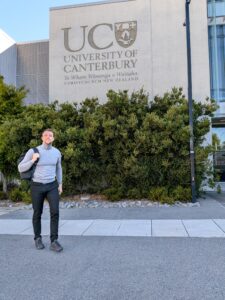
In Christchurch war ich am SERG an einem RWTH-geführten Horizon-Europe-Konsortium im Built4People-Kontext angebunden. Inhaltlich adressiert der Call innovative Pfade zur Dekarbonisierung und Klimaanpassung des Gebäudebestands und betont dabei Skalierbarkeit, Validierung in mehreren Ländern sowie die Einbindung relevanter Stakeholder entlang der Wertschöpfungskette. (CORDIS)
Als Projektverantwortlicher habe ich vor Ort insbesondere:
- die technische und konzeptionelle Abstimmung zwischen europäischen und neuseeländischen Partnern koordiniert,
- die Beiträge konsistent in die Gesamtarchitektur des Antrags integriert,
- die finale Einreichung im Zeitfenster der Ausschreibung aus Christchurch heraus abgeschlossen.
Der Call selbst war im EU Funding & Tenders Portal mit Öffnung im September 2025 und einer Deadline Mitte Februar 2026 gelistet. (European Commission)
Damit wurde der Aufenthalt auch organisatorisch zu einem „Real-Life-Stresstest“: internationale Zeitzonen, parallele Abstimmungsprozesse und die Notwendigkeit, in kurzer Zeit belastbare Konsenspositionen herzustellen.
Wissenschaftlicher Austausch und Sichtbarkeit
Während meines Aufenthalts habe ich meine Forschung und die Arbeit meines Instituts an der RWTH Aachen University (insbesondere zu E-Mobilität, Energiespeichern, Demand-Side-Flexibilität und Energiesystemintegration) in zwei Formaten vorgestellt:
- SERG Research Talk in Christchurch
- OERC Seminar in Dunedin
Als Research Associate und PhD-Kandidat in der Energiewirtschaft arbeite ich an der Schnittstelle von Energiesystemen, Marktmechanismen und Akzeptanz bzw. Nutzerverhalten, unter anderem zu dynamischer Bepreisung und Flexibilitätsoptionen.
Die Präsentationen waren besonders wertvoll, weil sie nicht nur Forschungsergebnisse „exportiert“ haben, sondern die Gelegenheit boten, die Anschlussfähigkeit an die neuseeländische Forschungsagenda konkret zu diskutieren (z.B. Gebäudebestand, Systemintegration erneuerbarer Energien, Elektrifizierung).
Zweiter Standort: University of Otago
Der anschließende Aufenthalt in Dunedin war ein bewusst gesetzter zweiter Ankerpunkt. „Ergebnisoffenes“ Ziel war es, eine zusätzliche institutionelle Schnittstelle aufzubauen und den Austausch mit der lokalen Energie-Forschungsgemeinschaft zu vertiefen. Das hat die Kooperationsperspektive deutlich verbreitert, fachlich wie organisatorisch.
4. Finanzierung und Kosten
Neuseeland ist insgesamt ein Land mit geringeren Lebenshaltungskosten als viele Studierende und Forschende es aus Deutschland gewohnt sind, insbesondere bei Lebensmitteln und Restaurantbesuchen. Voraussetzung für diese Wahrnehmung ist das deutsche Gehalt, denn das Lohnniveau der NeuseeländerInnen ist geringer als das der Deutschen.
Dennoch gibt es gewisse Kostentreiber
- Unterkunft: Kurzzeitmieten schlagen stark zu Buche, vor allem bei guter Lage und möblierter Ausstattung.
- Mobilität: Innerstädtisch geht vieles mit Bus und zu Fuß, aber für Ausflüge und interregionale Wege sind Mietwagen oder Inlandsflüge häufig die realistischen Optionen.
- Lebensmittel: Wenn man sich abseits der lokal hergestellten Nahrungsmittel kulinarisch bewegen will. Produkte aus Europa (z.B. Mozzarella, Parmesan, Olivenöl) sind verständlicherweise teurer.
Praktische Punkte
- Eine Kreditkarte ohne Auslandsgebühren ist sehr hilfreich.
- Viele Zahlungen laufen kontaktlos, Bargeld ist nebensächlich (habe genau gar keins gebraucht).
5. Freizeit, Kultur, Insider-Tipps
Neuseeland eignet sich hervorragend, um Naturerlebnis und Arbeitsalltag zu verbinden, gerade weil viele Orte in kurzer Zeit erreichbar sind, wenn man Wochenenden strategisch nutzt.
Rund um Christchurch
- Port Hills für kurze After-Work-Hikes mit Blick über die Stadt
- Banks Peninsula und Akaroa für Küstenlandschaft und „kleine Auszeit“
- Tages- oder Wochenendtrip Richtung Arthur’s Pass oder Lake Tekapo (Wetterfenster beachten)
Rund um Dunedin
- Otago Peninsula (Natur, Küste, Wildlife)
- Moeraki Boulders als klassischer Abstecher an der Küste
- Die Catlins, wenn man ein langes Wochenende einplanen kann
Kulturell
Was ich besonders positiv erlebt habe: eine sehr zugängliche Gesprächskultur im akademischen Umfeld und eine hohe Selbstverständlichkeit interdisziplinärer Perspektiven, gerade in Energie- und Gebäudethemen (Technik, Policy, soziale Dimensionen).
6. Mehrwert für Studien- und Karriereweg und gesellschaftlicher Nutzen
Der Aufenthalt hat meinen akademischen Weg in mehrfacher Hinsicht konkret gestärkt:
Karriere- und Forschungsmehrwert
- Internationale Leitungserfahrung: Die Antragseinreichung unter realen Zeit- und Koordinationsbedingungen hat Projektführungsfähigkeiten in einem Horizon-Europe-Setting deutlich geschärft.
- Inhaltliche Erweiterung: Der neuseeländische Kontext (Gebäudebestand, Klima, Systembedingungen) hat neue Vergleichs- und Transferfragen eröffnet, die ich in meine Forschung zurücktrage.
- Sichtbarkeit der RWTH: Durch Vorträge und institutionelle Anbindung wurde RWTH-Forschung in der lokalen Community präsent und konkret „adressierbar“.
Gesellschaftlicher Nutzen (Transfergedanke)
Ein persönlicher roter Faden meiner Arbeit ist die Frage, wie Energiewende praktisch akzeptiert, verstanden und mitgetragen werden kann. Ich engagiere mich dafür auch außerhalb der Universität, etwa über Formate zur Energiekompetenz und zur Verbindung von Technik, Kosten und Alltagsrealität.
Die neuseeländischen Gespräche haben mir neue Beispiele geliefert, wie Kommunikation über Energie und Gebäude stärker nutzerzentriert und weniger technokratisch gelingen kann.
7. Nachhaltiger Charakter des Auslandsaufenthalts
Der nachhaltige Charakter meines Aufenthalts ergibt sich aus drei Punkten:
- Verstetigung von Kooperationen: Der Besuch war nicht nur Networking, sondern direkt in ein gemeinsames, strategisches Vorhaben eingebettet (Built4People/Horizon Europe). (CORDIS)
- Zwei institutionelle Anker: Christchurch und Dunedin bilden zwei Kontaktpunkte, die perspektivisch unterschiedliche Kooperationspfade eröffnen (thematisch wie personell).
- Wissenschaftliche Anschlussfähigkeit: Es sind gemeinsame Paper-Ideen, die Bereitschaft von Daten- und Methodenaustausch, mögliche Co-Supervisionen und Gastvorträge entstanden.
8. Fazit
Als RWTH Research Ambassador in Neuseeland war mein Aufenthalt mehr als ein klassischer Forschungsbesuch. Er war eine Kombination aus Projektverantwortung, wissenschaftlicher Sichtbarkeit und gezieltem Aufbau belastbarer Partnerschaften. Besonders wertvoll war die Erfahrung, einen zentralen Antragsschritt eines internationalen Konsortiums direkt vor Ort zu finalisieren und gleichzeitig RWTH-Forschung im neuseeländischen Kontext zu positionieren.
Ich bin dankbar für das Vertrauen, das mir mit dem Stipendium entgegengebracht wurde, und sehe in den geknüpften Kooperationen eine sehr konkrete Basis für langfristige gemeinsame Forschung und nachhaltigen Wissenstransfer zwischen RWTH Aachen University und Partnern in Neuseeland.
