
Schlagwort: ‘energy engineering’
Mein Aufenthalt als RWTH Research Ambassador in Neuseeland
- PhD-Kandidat in der Energiewirtschaft
- Neuseeland, Christchurch und Neuseeland, Dunedin
- University of Canterbury und University of Otago
- 01/2026 – 04/2026
1. Vorbereitung und Organisation des Aufenthalts
Die Vorbereitung meines Aufenthalts in Neuseeland begann mit der fachlichen Abstimmung mit den Gastgebern und der formalen Einbettung in die jeweiligen Strukturen der Partneruniversitäten. Es wurde direkt zu Beginn klar gemacht, dass man eigenes Funding mitbringen muss. Da dies in meinem Fall gegeben war, war der Kontakt mit den ForschungsgruppenleiterInnen pragmatisch und “welcoming”.
Gastuniversitäten und Einbindung
-

©International Office
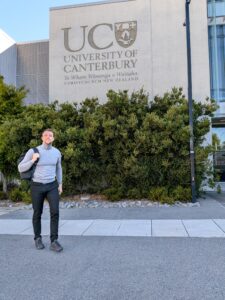
University of Canterbury (Christchurch): Sustainable Energy Research Group (SERG)
- University of Otago (Dunedin): Austausch mit der lokalen Energieforschung

Inhaltlich stand von Beginn an fest, dass der Aufenthalt in Christchurch nicht nur einem klassischen Forschungsbesuch dienen sollte, sondern die gezielte Weiterentwicklung und Finalisierung einer internationalen Kooperation im Themenfeld „low carbon und climate resilient buildings“ im Kontext der Horizon Europe Förderlandschaft vorantreibt. Der Forschungsaufenthalt in Dunedin war jedoch ergebnisoffen.
Visa, Einreise, Versicherung (Rahmenbedingungen)
Für deutsche Staatsangehörige ist bei Kurzaufenthalten häufig eine Einreise über das Visa Waiver Programm mit vorheriger NZeTA-Beantragung möglich; bei Einreise kann dann ein Besuchsstatus von bis zu 3 Monaten gewährt werden. (Immigration New Zealand)
In der Praxis lohnt es sich, früh zu prüfen, ob die eigene Tätigkeit (z.B. Forschungsaufenthalt ohne lokale Vergütung) vollständig mit dem gewählten Status kompatibel ist, und ob zusätzliche Anforderungen der Gastinstitution (z.B. Nachweise zur Krankenversicherung) gelten.
Zusätzlich sollte man die International Visitor Conservation and Tourism Levy (IVL) einplanen, die bei vielen Einreise- und Visaprozessen anfällt und aktuell bei NZD 100 liegt. (Immigration New Zealand)
Reiseorganisation
Da Neuseeland sehr weit entfernt ist, sind Jetlag und „Ankommenszeit“ realistische Faktoren in der Planung. Ich habe daher bewusst Puffer für die ersten Arbeitstage eingeplant, um direkt arbeitsfähig zu sein. Für mobile Phasen (Christchurch und später Dunedin) hat es sich bewährt, Unterlagen digital und redundant verfügbar zu halten (Cloud plus Offline-Kopie), da man häufig zwischen Campus, Unterkünften und Terminen pendelt.
2. Erste Schritte nach der Ankunft und Qualität der Unterkunft
Nach der Ankunft standen zunächst pragmatische Dinge im Vordergrund: lokale SIM, grundlegende Orientierung, Wege zum Campus, sowie die Abstimmung der Arbeitsroutinen (Zugang, Büro, Meetingstruktur). Besonders hilfreich war, dass beide Universitäten mit internationalen Gästen routiniert umgehen und entsprechende Kontaktpunkte anbieten.
Unterkunft
In Neuseeland ist der Wohnungsmarkt in Universitätsstädten spürbar angespannt, und kurzfristige, möblierte Optionen sind häufig deutlich teurer als langfristige Mietverträge. Für Forschungsaufenthalte mit Standortwechsel ist eine möblierte Kurzzeitlösung dennoch meist die praktikabelste Option. Aus meiner Sicht lohnt sich:
- frühzeitige Suche über AirBnb oder Uniangebote (je nach Saison mehrere Wochen bis Monate vorher),
- klare Lageprioritäten (Nähe zum Campus vs. Innenstadt),
- Heizstandard/Isolierung aktiv prüfen, weil Gebäudequalität stark variieren kann (gerade im Winterhalbjahr à für mich nicht relevant, da Sommer).
3. Akademische und berufliche Erfahrungen
Der Kern meines Aufenthalts war die Kombination aus inhaltlicher Projektarbeit, institutioneller Repräsentation und strategischer Netzwerkentwicklung.
Forschungs- und Projektfokus
©International Office
In Christchurch war ich am SERG an einem RWTH-geführten Horizon-Europe-Konsortium im Built4People-Kontext angebunden. Inhaltlich adressiert der Call innovative Pfade zur Dekarbonisierung und Klimaanpassung des Gebäudebestands und betont dabei Skalierbarkeit, Validierung in mehreren Ländern sowie die Einbindung relevanter Stakeholder entlang der Wertschöpfungskette. (CORDIS)
Als Projektverantwortlicher habe ich vor Ort insbesondere:
- die technische und konzeptionelle Abstimmung zwischen europäischen und neuseeländischen Partnern koordiniert,
- die Beiträge konsistent in die Gesamtarchitektur des Antrags integriert,
- die finale Einreichung im Zeitfenster der Ausschreibung aus Christchurch heraus abgeschlossen.
Der Call selbst war im EU Funding & Tenders Portal mit Öffnung im September 2025 und einer Deadline Mitte Februar 2026 gelistet. (European Commission)
Damit wurde der Aufenthalt auch organisatorisch zu einem „Real-Life-Stresstest“: internationale Zeitzonen, parallele Abstimmungsprozesse und die Notwendigkeit, in kurzer Zeit belastbare Konsenspositionen herzustellen.
Wissenschaftlicher Austausch und Sichtbarkeit
Während meines Aufenthalts habe ich meine Forschung und die Arbeit meines Instituts an der RWTH Aachen University (insbesondere zu E-Mobilität, Energiespeichern, Demand-Side-Flexibilität und Energiesystemintegration) in zwei Formaten vorgestellt:
- SERG Research Talk in Christchurch
- OERC Seminar in Dunedin
Als Research Associate und PhD-Kandidat in der Energiewirtschaft arbeite ich an der Schnittstelle von Energiesystemen, Marktmechanismen und Akzeptanz bzw. Nutzerverhalten, unter anderem zu dynamischer Bepreisung und Flexibilitätsoptionen.
Die Präsentationen waren besonders wertvoll, weil sie nicht nur Forschungsergebnisse „exportiert“ haben, sondern die Gelegenheit boten, die Anschlussfähigkeit an die neuseeländische Forschungsagenda konkret zu diskutieren (z.B. Gebäudebestand, Systemintegration erneuerbarer Energien, Elektrifizierung).
Zweiter Standort: University of Otago
Der anschließende Aufenthalt in Dunedin war ein bewusst gesetzter zweiter Ankerpunkt. „Ergebnisoffenes“ Ziel war es, eine zusätzliche institutionelle Schnittstelle aufzubauen und den Austausch mit der lokalen Energie-Forschungsgemeinschaft zu vertiefen. Das hat die Kooperationsperspektive deutlich verbreitert, fachlich wie organisatorisch.
4. Finanzierung und Kosten
Neuseeland ist insgesamt ein Land mit geringeren Lebenshaltungskosten als viele Studierende und Forschende es aus Deutschland gewohnt sind, insbesondere bei Lebensmitteln und Restaurantbesuchen. Voraussetzung für diese Wahrnehmung ist das deutsche Gehalt, denn das Lohnniveau der NeuseeländerInnen ist geringer als das der Deutschen.
Dennoch gibt es gewisse Kostentreiber
- Unterkunft: Kurzzeitmieten schlagen stark zu Buche, vor allem bei guter Lage und möblierter Ausstattung.
- Mobilität: Innerstädtisch geht vieles mit Bus und zu Fuß, aber für Ausflüge und interregionale Wege sind Mietwagen oder Inlandsflüge häufig die realistischen Optionen.
- Lebensmittel: Wenn man sich abseits der lokal hergestellten Nahrungsmittel kulinarisch bewegen will. Produkte aus Europa (z.B. Mozzarella, Parmesan, Olivenöl) sind verständlicherweise teurer.
Praktische Punkte
- Eine Kreditkarte ohne Auslandsgebühren ist sehr hilfreich.
- Viele Zahlungen laufen kontaktlos, Bargeld ist nebensächlich (habe genau gar keins gebraucht).
5. Freizeit, Kultur, Insider-Tipps
Neuseeland eignet sich hervorragend, um Naturerlebnis und Arbeitsalltag zu verbinden, gerade weil viele Orte in kurzer Zeit erreichbar sind, wenn man Wochenenden strategisch nutzt.
Rund um Christchurch
- Port Hills für kurze After-Work-Hikes mit Blick über die Stadt
- Banks Peninsula und Akaroa für Küstenlandschaft und „kleine Auszeit“
- Tages- oder Wochenendtrip Richtung Arthur’s Pass oder Lake Tekapo (Wetterfenster beachten)
Rund um Dunedin
- Otago Peninsula (Natur, Küste, Wildlife)
- Moeraki Boulders als klassischer Abstecher an der Küste
- Die Catlins, wenn man ein langes Wochenende einplanen kann
Kulturell
Was ich besonders positiv erlebt habe: eine sehr zugängliche Gesprächskultur im akademischen Umfeld und eine hohe Selbstverständlichkeit interdisziplinärer Perspektiven, gerade in Energie- und Gebäudethemen (Technik, Policy, soziale Dimensionen).
6. Mehrwert für Studien- und Karriereweg und gesellschaftlicher Nutzen
Der Aufenthalt hat meinen akademischen Weg in mehrfacher Hinsicht konkret gestärkt:
Karriere- und Forschungsmehrwert
- Internationale Leitungserfahrung: Die Antragseinreichung unter realen Zeit- und Koordinationsbedingungen hat Projektführungsfähigkeiten in einem Horizon-Europe-Setting deutlich geschärft.
- Inhaltliche Erweiterung: Der neuseeländische Kontext (Gebäudebestand, Klima, Systembedingungen) hat neue Vergleichs- und Transferfragen eröffnet, die ich in meine Forschung zurücktrage.
- Sichtbarkeit der RWTH: Durch Vorträge und institutionelle Anbindung wurde RWTH-Forschung in der lokalen Community präsent und konkret „adressierbar“.
Gesellschaftlicher Nutzen (Transfergedanke)
Ein persönlicher roter Faden meiner Arbeit ist die Frage, wie Energiewende praktisch akzeptiert, verstanden und mitgetragen werden kann. Ich engagiere mich dafür auch außerhalb der Universität, etwa über Formate zur Energiekompetenz und zur Verbindung von Technik, Kosten und Alltagsrealität.
Die neuseeländischen Gespräche haben mir neue Beispiele geliefert, wie Kommunikation über Energie und Gebäude stärker nutzerzentriert und weniger technokratisch gelingen kann.
7. Nachhaltiger Charakter des Auslandsaufenthalts
Der nachhaltige Charakter meines Aufenthalts ergibt sich aus drei Punkten:
- Verstetigung von Kooperationen: Der Besuch war nicht nur Networking, sondern direkt in ein gemeinsames, strategisches Vorhaben eingebettet (Built4People/Horizon Europe). (CORDIS)
- Zwei institutionelle Anker: Christchurch und Dunedin bilden zwei Kontaktpunkte, die perspektivisch unterschiedliche Kooperationspfade eröffnen (thematisch wie personell).
- Wissenschaftliche Anschlussfähigkeit: Es sind gemeinsame Paper-Ideen, die Bereitschaft von Daten- und Methodenaustausch, mögliche Co-Supervisionen und Gastvorträge entstanden.
8. Fazit
Als RWTH Research Ambassador in Neuseeland war mein Aufenthalt mehr als ein klassischer Forschungsbesuch. Er war eine Kombination aus Projektverantwortung, wissenschaftlicher Sichtbarkeit und gezieltem Aufbau belastbarer Partnerschaften. Besonders wertvoll war die Erfahrung, einen zentralen Antragsschritt eines internationalen Konsortiums direkt vor Ort zu finalisieren und gleichzeitig RWTH-Forschung im neuseeländischen Kontext zu positionieren.
Ich bin dankbar für das Vertrauen, das mir mit dem Stipendium entgegengebracht wurde, und sehe in den geknüpften Kooperationen eine sehr konkrete Basis für langfristige gemeinsame Forschung und nachhaltigen Wissenstransfer zwischen RWTH Aachen University und Partnern in Neuseeland.
My experiences at Volvo Technology
- Energy Engineering M.Sc.
- Sweden, Göteborg
- Volvo Technology
- 10/2024 – 05/2025
Hello, my name is Marc. I am a German studying Master Energy Engineering at RWTH Aachen University, Germany, and participated in a research stay funded by the Erasmus+ Internship program during my master’s thesis at Volvo Technology – one of the most Swedish companies imaginable – in the second largest city Göteborg, Sweden. Getting this opportunity, to work on practical research in a company, was very difficult and almost did not work out. I started applying more than a year ahead, but this was way too early for most cases. In Sweden, there are no mandatory internships of up to 6 months; Swedish students gain practical experience during their summer break. Yes, you heard right: all students have a 2-3 month study-free period during the summer, without the need to prepare for exams, since they finish them before Midsommar (the summer solstice). Their internship culture comes from the fact that students do not receive their student funding during vacation, so many rely on summer jobs to survive financially until the next study period. Because internships are limited to these three months, companies don’t know about longer internships, especially not outside this period, as is common in Germany. Another aspect is that thesis work usually starts in January, as Swedish studies are separated into four periods, and are mainly carried out in groups of two—eliminating most chances if you want to start according to the German semester dates and alone. However, you would not be reading this if I hadn’t made it despite the low chances. I applied a lot, sent unsolicited applications to companies, connected with people on LinkedIn, and sent dozens of requests for an internship with the opportunity to follow up with a master’s thesis, which is usually the catch in Germany. The position was acquired via an unsolicited application to an industrial PhD student in cooperation between Chalmers University of Technology and Volvo Group, which led to the position at Volvo Technology. Other research internships would have been possible at Chalmers, but the research topic and work environment at Volvo were the best option.
Finding a suitable accommodation without being registered as a Swedish student brings further problems, since you are not eligible for student accommodations. Some shared living opportunities always exist but are highly requested and not available in sufficient quantity. Some international students even live in hotels or cabins for the first year. In Swedish metropolitan areas, housing agencies require you to be in the queue for several years. Even colleagues at my workplace, who were in the queue for up to three years, were not able to find suitable accommodation (for their living standard) and ended up buying instead. I found mine with a lot of luck on Facebook (which is widely used in Scandinavia and also serves as an online marketplace and for international exchange). The accommodation had two rooms, one bedroom, and one living room/kitchen. The monthly costs were approximately €450 per person, with all additional costs included. I lived there with my girlfriend, who also studied at Göteborg University. For grocery shopping, I highly recommend using “Too Good To Go,” which offers a full bag of vegetables close to expiration for under €5—this saves money since vegetables and fruits are noticeably more expensive compared to Germany. Monthly expenses for groceries were roughly €200 per person, including all food and household costs and eating out every two weeks. Since the canteen at Chalmers was €6 (student) or €8 (visitor), and at Volvo Group €10, I decided to always prepare my own food, which is popular in Sweden. There are always spaces with microwaves and cutlery. For transportation, you can use rental bikes for €30 per year (Nextbike/Sty&Ställ). Since I needed to get to the other side of the harbor to Göteborg Lundby, I bought a tram ticket, which was €60 (student) or €75 (non-student) per month. Even though I was a student, I couldn’t use the student discount for many occasions, since in Sweden your student status is verified by a “Mecenat” app account issued by a Swedish university, which I did not have.
Everyday life during the research stay was a 40-hour workweek, starting at 9:00 and ending at 17:00. It is common to have a one-hour lunch break at 11:00, which I always spent with coworkers. Since I started in October, I was the only student at the company until January, when two other thesis workers joined, as is usual during this time. From Volvo, I received a laptop for my research work, which was mainly self-guided and supervised by weekly meetings with my supervisor. I highly enjoyed short coffee breaks with colleagues around 14:00-15:00, called “fika,” to discuss technical topics or daily life. There was one 30-minute fixed slot per week where the whole department met, and one colleague always brought sweet pastries or cake. The department worked great as a team, and I think this weekly contact, as well as spontaneous meetings on other days, helps with teambuilding. I also enjoyed that Volvo Group is an international environment, and you can get into contact with everyone on a casual basis since in Sweden you always call people by their first name; titles and positions do not mainly define your personality.
During the winter, I came home from work when it was already dark, but there are many options available. Monthly sports membership at “Fysiken” cost €33 per month (3-month period) for students, including gym, courses, team play, and climbing/bouldering. I used to go every second day and made friends during climbing and basketball. It seems much easier to make international friends, as Swedish students usually already have their friend groups. Getting into those groups takes time and is comparable to making friends in Germany. With friends found that way, at the company or through international university programs such as ESN, you will definitely find people to spend time with—though more likely internationals who will leave after six months. However, Göteborg is a city where you can spend your time at many places, such as bars with after-work discounts and pub quizzes, museums, or at the ice hockey arena watching “Frölunda HC.” Around February, you will get home when it is still bright outside and can spend the sunset at famous places such as “Skansen Kronan.” On weekends, I recommend visiting the local historical
amusement park “Liseberg,” the islands in the archipelago near Gothenburg, one of the beaches, or hiking around lakes such as “Delsjön.” Trips around Sweden to Stockholm, Malmö, Helsingborg, or even Oslo in Norway are easy to do on a small budget. ESN also offered a one-week trip to Swedish Lapland, which everyone recommended to me, but I was quite
occupied by research work and also took vacation to visit my family over Christmas.
In conclusion, I liked Swedish culture before, and this trip increased its attraction. Sometimes it was tough to receive the same rights as locals, since you always need digital proof such as Swedish student status (“Mecenat”). For foreigners, it is also impossible to buy at a local food market or farm since “Swish,” the Swedish version of PayPal for payment, requires a Coordination Number for a Swedish ID, a Swedish bank account, and BankID. There are also several special days with traditions such as St. Lucia around Christmas, Valborg/Walpurgis Night and Swedish National Day in spring, and Midsommar in summer. However, my girlfriend and I decided to continue our time in Sweden and enjoy one or more summers at the coast and in nature, where Sweden has much to offer.
Writing my Master Thesis in Trondheim
- Energy Engineering M. Sc.
- Norway, Trondheim
- Norges Teknisk-Naturvitenskapelige Universitet
- 01/2024-06/2024
Application / Finding an internship
To make new experiences and broaden my horizon I wanted to finish my academic studies with a stay abroad. So, I decided to do my master thesis in another country. I already had a research topic in mind and knew I wanted to go to another European country, thus I came across the NTNU in Trondheim, Norway – a place which seemed to be popular among engineering students from RWTH Aachen University. I did not apply for an advertised thesis, instead I had to demarcate the topic together with both my Norwegian supervisor and my German supervisor. Yet, the application process was surprisingly straightforward. I wrote an e-mail to the corresponding professor at NTNU, and he replied with a few hours and accepted my proposal. Additionally, I had to register myself as an exchange student at NTNU. The university’s international office was very supportive in that process. A benefit as an exchange student is that you are exempt from paying the semester fee.
Accommodation & living expenses
Since my stay in Trondheim was aligned with the Norwegian spring semester (January – June) I was given the chance to live in the Moholt student village (dorm). I can highly recommend Moholt to any exchange student because it makes your stay in Trondheim so much more enjoyable. First of all, the dorm rooms are very modern and well equipped. I lived in a 4-bedroom-apartment with three other students with shared kitchen and bathroom. The apartment had two big fridges, an oven with induction cooktop and a microwave – so well suited for cooking with friends. One big disadvantage is that the personal (bed)rooms are not equipped with a mattress. You either have to buy a new one (there is a furniture store right across the street) or get one from students who are leaving (there are Facebook and WhatsApp groups to organize buying and selling used stuff). Furthermore, there is a thing called Re:Store at Moholt where you can get used furniture and other household items for free which where donated by other students. In return, you can donate your used stuff when you leave. In case you need outdoor/hiking/sports equipment, you can go to the Bumerang store (also located at Moholt) where you can lend almost everything needed for outdoor activities (backpacks, skis, tents, …) without cost.
However, the best part of Moholt in my opinion is the Loftet. The Loftet is a common room located in the center of the village opened every day. It is equipped with tables where you can work as well as a lot of sofas where you can just relax. You can get a free cup of coffee or tea, pick one of a great variety of board games or play table tennis or video games on a PS5. The Loftet is run by very friendly volunteering students who work for Sit (the welfare organization for students) and can help you with almost anything. There are several recurring events, such as movie nights, quizzes, jam sessions, guided hiking tours etc. So, when you don’t know what to do – just go to the Loftet. The chances you’ll meet new interesting people and be involved in funny activities are quite high. It’s worth mentioning that the community at Moholt is very international.
Regarding the cost of living, the amount of money provided by the ERASMUS+ scholarship (750 €) was sufficient. The rent was approximately 400 euros (costs for internet and electricity are included). A six-months-ticket for the public transport costs about 250 euros. The food prices are extremely high compared to most other European countries. Especially basic groceries (water, milk, butter, cheese, vegetables) cost twice as much as in Germany. What’s also expensive is any close contact service, e.g. eating at a restaurant or going to the barber. Yet, if you are person who basically spends his or her money only (or mainly) on necessary things (groceries, toiletries, stationery, …) you will get along well with 750 € a month. If, on the other hand, you like to get take-away food often, go to clubs, bars, cinemas weekly, enjoy frequent shopping trips or have an expensive hobby, you might exceed the monthly stipend.
Everyday life / the internship
Paying bills in Norway works (almost) completely cashless. I have never held a Norwegian bank note in my hand, credit cards (or NFC-enabled smartphones) are accepted basically everywhere. Therefore, you should get a credit card that doesn’t charge fees for paying in foreign currency. Alternatively, you can link your PayPal account with Google Wallet. By doing that you also avoid those extra fees. Most Norwegians are fluent in English which makes communicating in everyday life very easy.
Since Trondheim is located quite northern on the globe the transition period from winter to summer is quite short. When I arrived in January the temperature was -13°C in the evening. There was a lot of snow until the beginning of April and the sun set very early (before 4:30 pm). Though from mid-April on there was a rapid change and in May temperatures sometimes went beyond 25°C and the sun did not set before 11 pm. So even when you finished working late, you could enjoy some hours of free time outside.
Working on my thesis was difficult in the first few weeks (and months to be honest). Since I had not applied for an advertised thesis a major, time-consuming part of my stay at NTNU was to formulate a research question which was relevant to both ‘sides’ (German and Norwegian). My Norwegian supervisor was actually the professor himself, who obviously has a tighter schedule than research assistants, which is why I did not meet him every week. The NTNU provides open offices at the campus particularly reserved for students. Unfortunately, the university cafeterias are extremely expensive (a meal costs 3-4 times as much as in Germany) which is why I worked from ‘home’ most of the time so that I was able to cook my own lunch.
Free time / tips
When you stay in Norway for a longer period, it is definitely worth experiencing the beautiful nature of the country. A great way to do that is going on a hike and staying overnight in one of the many cabins which NTNU owns. The cabins are neither equipped with electricity nor running water, to keep it warm you chop some wood and put it into the oven that is present in every cabin. Anything else – food, drinks, sleeping bags etc. – you must bring yourself. Although this may sound a little scary at the beginning, it really offers a cool and unique experience. Some cabins are located on a lake, some come with a sauna and above all you get a great view of the landscape.
From my experience, one might feel a little overwhelmed at first by all the opportunities to spend your free time. A good strategy is to start by joining the trips guided by the Sit students (starting at Loftet) to find out what kind of trip or activity suits you.
With the regard to writing a master thesis abroad, I’d recommend the following:
1) Align your stay in Norway with the semester cycle. That allows you to get a place in one of the student villages with all the benefits mentioned above.
2) If possible, find an advertised thesis with a (more or less) predefined research question. That will reduce the amount of required communication and coordination between your internal (your home university) and external (Norwegian) supervisor.
3) Draft a schedule for the different tasks of your thesis together with your supervisors. Think about what input you need from which supervisor (internal or external).
4) If you’re stuck at some point, don’t be afraid to ask your supervisor for help.
Conclusion
Trondheim is a great place to study. The people I have met there were extremely friendly without exception. The student welfare organization Sit provides a very comfortable living environment. It is important to take care of administrative stuff early enough (finding a topic and a supervisor, register as an exchange student, find housing, apply for ERASMUS funding, get adequate insurance). Yet, if you are facing problems during your stay there are many people and institutions who can help you. Personally, I would do some things differently in retrospect, nevertheless, I am very grateful for having made the experience.
