
Schlagwort: ‘Molecular and Applied Biotechnology (MA)’
Researching Abroad: My 9-Month Experience in Canada
- Molecular and Applied Biotechnology M.Sc.
- Canada, Edmonton
- University of Alberta
- 04/2025 – 01/2026
How It All Started – Motivation and First Steps
Having already spent time in Canada during my Bachelor’s studies in Vancouver, I initially planned to pursue my Master’s research in a different country in order to gain new perspectives and challenges. However, the long-standing partnership between RWTH Aachen and the University of Alberta (UofA) changed my plans, and the opportunity to return to Canada ultimately felt both natural and exciting. Supported by the RWTH Aachen Junior Research Fellowship and subsequently the UARE Scholarship from the UofA, I was able to complete my Master’s thesis in Edmonton. This gave me the chance to experience a completely different side of Canada compared to my earlier stay on the west coast.
Finding My Place in Edmonton – Campus
After arriving in Edmonton, I focused on settling into my accommodation, opening a bank account, and becoming familiar with the university campus. While many students go for shared flats or studio apartments, I chose to live with a host family, a rather uncommon option, but for me the best decision. Living with a local family offered valuable insights into everyday Canadian life and culture. Thanks to the UofA guidance handbook and the advisors for international students, the administrative process was surprisingly smooth. Whenever questions arose, reliable support was available. The International Office played an important role during this initial phase and throughout my stay. The staff were helpful, even beyond regular office hours, ensuring that potential issues were resolved quickly and efficiently.
©International Office
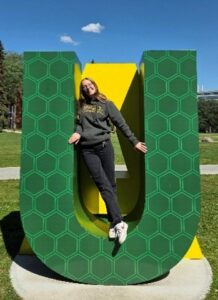
Compared to RWTH Aachen University, the campus in Edmonton felt like a small town, with its own libraries, cafés, sports facilities, and green spaces. Finding my way around this environment was an adventure itself. Over time, however, it became familiar, and certain places, such as my lab, the Student Union Building (SUB), the gym, and the swimming pool, became anchors in my daily life.
Integrating into my research group was another key step. Although English was the working language, the team was highly international, bringing together students and researchers from diverse academic and cultural backgrounds. This created an open and dynamic atmosphere, while also requiring initiative and independence. Learning when to seek guidance, when to work autonomously, and how to communicate effectively in this environment became an essential part of my integration.
Learning, Struggling, Growing – My Research Experience
Working in a research laboratory at the UofA was both exciting and demanding from the very beginning. The first weeks were dedicated to orientation and training, including mandatory safety courses, laboratory inductions, and equipment certifications required before conducting independent experiments. During this period, I also familiarized myself with ongoing projects in the group, observed other students’ work and assisted in experiments. This helped me understand the broader scientific framework of our research and how individual experiments contributed to the overall goals.
After the training phase, I was given a high degree of freedom to develop my own project within the group’s overarching research goals. While this autonomy was highly motivating, it also became one of the greatest challenges of my stay. Aligning academic expectations from both Germany and Canada, establishing a realistic timeline, and coordinating communication across time zones required careful planning. Additionally, assessing available equipment and resources to design feasible experiments demanded a high degree of organization. Compared to my previous academic experiences, the level of autonomy was significantly higher. Although supervision was readily available when needed, my day-to-day progress depended largely on my own initiative, organizational skills, and problem-solving abilities.
As time passed, I learned how to manage the responsibility of working independently while seeking feedback when necessary. This balance between autonomy and guidance became one of the most valuable elements of my stay and marked a significant step in my development as an independent researcher.
Beyond the Lab – Life in Canada Outside of Work
While my research represented a significant part of my daily routine, life outside the lab was equally important to make my stay truly memorable. Spending time in nature, exploring new places, and sharing moments with friends provided a valuable balance to the intensity of academic work.
The university’s International Office organized a wide range of social and cultural events that made it easy to connect with other students and build a supportive network. One particularly enriching opportunity was joining the Language Club, which brought together students interested in practicing different languages. These informal meetings were a relaxed way to engage in cultural exchange and helped me maintain and expand my language skills while making new friends from diverse backgrounds.
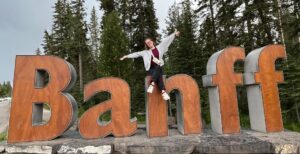
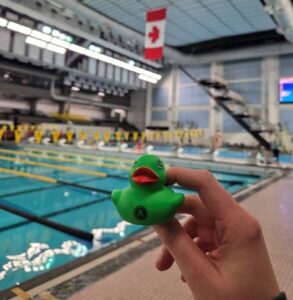
Over the course of the year, I noticed seasonal differences in campus life. While the summer term was relatively quiet, the fall term brought numerous new events, student initiatives, and opportunities to join sports clubs and societies. I personally joined the university swim club, which allowed me to register as a Canadian swimmer and participate in local competitions, a fantastic experience! Beyond sports, I also found moments of balance through music. Several pianos were freely accessible across the campus, and I often used them in the early morning hours, when the university was still calm and nearly empty. Additionally, attending Edmonton Oilers ice hockey games and spending time in nature, particularly in the Canadian Rockies, were memorable experiences that balanced the intensity of my research work. The hiking trips to the Banff and Jasper National Parks with their breathtaking landscapes, were among the most impressive experiences of my stay.
©International Office
©International Office
Looking Back – What I Take With Me
Reflecting on my nine months in Canada, it’s clear how this experience shaped my academic and personal development. While my studies at RWTH Aachen provided a strong scientific foundation, my time at the University of Alberta required me to apply this knowledge in a much more independent and self-directed way. Taking responsibility for my own project, making decisions with limited guidance, and adapting to a different academic culture had a lasting impact on my approach to research. The international environment in Edmonton further broadened my perspective on collaboration and academic careers. Working alongside students and researchers from many different cultural and educational backgrounds reinforced the importance of openness, mutual respect, and diverse viewpoints in advancing research. These experiences strengthened my understanding of what it means to be part of a global research community.
For future students considering a similar path, I highly recommend pursuing international exchange opportunities. Starting the application process early, actively reaching out to supervisors, and being open to stepping outside your comfort zone are key to success. Approaching the experience with curiosity and openness will help you benefit fully from both the academic and personal dimensions of studying abroad.
For me, my time in Canada was far more than just a temporary change of location. It was a formative period that helped shape my academic interests, career aspirations, and personal outlook. The skills, experiences, and friendships I gained continue to influence my path today. I am deeply thankful for this experience.
My Internship at the University College Dublin
- Molecular and Applied Biotechnology M.Sc.
- Irland, Dublin
- University College Dublin
- 04/2024 – 06/2024
Finding and Applying to an Internship
Before my stay abroad, I wasn’t sure where I wanted to go or what I wanted to do. However, when my girlfriend told me she was offered an internship position at a school in Dublin, my decision became clear. We decided that experiencing our internships abroad in the same city would make things easier, so I started searching for research groups in Dublin that interested me. I explored the websites of known universities, searching for researchers focused on bioprocessing, bioeconomy, and microbiology. I was particularly drawn to one research group, which aimed to utilize microalgae for the valorization of food waste. I directly applied for a three-month research internship, and after a few weeks and two Zoom calls, I was told that I could do the internship.
Accomodation and Living Expenses
Securing an affordable place to stay in Dublin was challenging. The city has a housing crisis, making flats very expensive. Student accommodations on the UCD campus were not a cheaper option, with the lowest price being 800 Euros per month for a shared room, and their application timeframes didn’t fit my schedule. Fortunately, I found a room in a shared apartment for 850 Euros per month on the website “Homestay”. At the start I was feeling very unaccustomed to living with a stranger but that feeling faded away with time when I got to know my flatmate better. The commute to the university was about 30 minutes, and a trip to the city centre took an hour. Despite living outside the city, I enjoyed the greenery, particularly Fernhill Park, which became one of my favorite spots in Dublin.
I usually did my grocery shopping after work once a week, as the smaller stores near my apartment were quite expensive. For example, cheese could cost up to 5 Euros per pack. Bulk shopping at a discount market was essential for affordable food, except for bread, which was inexpensive everywhere but of course not comparable to German bread 😉. I definitely recommend to only shop in large discounter markets in Ireland.
Everyday Live
I felt a bit nervous on my first day, but that quickly faded as I got to know the welcoming members of my research group. The lab environment and research methods were similar to those I was familiar with in Germany, which helped me settle in. Although the general approach was familiar, I still learned new laboratory techniques and tricks from my supervisor, especially regarding sterile work.
My tasks were divided between data analysis of existing literature and practical laboratory work with microalgae, known as wet-, reproducible outcomes. While there are standard practices, each lab has its own tricks lab or bench work. Working with microorganisms requires strict sterile conditions to prevent contamination and ensure predictable to maintain sterility, and I was grateful to learn new methods that were unfamiliar to me from my previous experience in German labs.
One aspect I appreciated about my work was the independence I had in deciding when and how to approach my tasks. Academics often start work later than usual, and this seemed even more common in Ireland. I typically worked from 9:30 am to 5 pm, but some colleagues started later and stayed longer.
In the evenings, I didn’t do much besides going for walks and cooking dinner, with leftovers serving as lunch the next day. Without a bike and with limited bus service in my area, my options for activities were slim. However, I eagerly looked forward to the weekends when I could explore more of Dublin and Ireland.
Free Time and Tips
Although my work group was friendly, social interactions outside work were limited to a monthly movie night. Luckily, I was part of a group of interns from the school where my girlfriend worked. Together, we made the most of our weekends by exploring Dublin’s pubs, restaurants, hiking trails, sightseeing spots, and local markets and art scenes.
Ireland’s pub culture is something special. On weekends, it’s common to go out, have a few pints, and dine at restaurants. Everyone is relaxed and enjoying the weekend atmosphere. Most pubs have live music, and the crowd cheers and sings along, creating a sense of unity and merriment that I have yet to experience in Germany. I personally loved the more traditional “Porterhouse” in the temple bar quarter but also the modern “bonobos” where tabletop games were played and who had a wide variety of all sorts of drinks. Dublin’s culinary scene is also diverse. I enjoyed Indian, Thai, Vietnamese, Spanish, and occasionally Irish food.
Apart from the bustling city, I loved Ireland’s nature the most. Green hills and meadows are everywhere, often contrasted by steep cliffs overlooking the sea. I often visited the peninsula of Howth, close to Dublin, taking all my visitors there because it is a must see for everyone visiting Dublin. It is a 50-minute bus ride from Dublin city center, but only 30 minutes from my girlfriend’s place, where I stayed most weekends. Two highlights at the end of my stay were trips to Galway and Belfast, where I experienced other cities in (Northern) Ireland and took a bus tour along the coast, where I could again awe the nature and the rougher northern coast line. When traveling Ireland, I would recommend taking the train if possible. Train tickets between the big cities cost only 8 Euros and the trains are very clean and spacious making the ride very pleasant. The best thing is: while driving you can view the beautiful landscape.
Conclusion
All in all I can say my internship in Dublin was a remarkable experience, both professionally and personally. I gained research skills, made new friends and could experience the culture of Ireland first hand for 3 month. Especially living and working in a foreign country is an experience that is hard to come by easer than with an Erasmus internship. I am happy I could have that experience and I am sure I will never forget it.
