
Schlagwort: ‘Krankenhaus’
My Clinical Elective in Granada
- Medicine
- Spain, Granada
- Universidad de Granada
- 11/2025 – 01/2026
1. Finding an Internship

©International Office
Organising clinical rotations as a medical student in Spain can be quite challenging, as most Spanish hospitals only accept foreign students during the summer months, when Spanish students are on break. I tried to obtain a placement in Madrid and Valencia without success but eventually secured an internship in the Department of General Surgery at Hospital Clínico San Cecilio through a personal connection via my Spanish teacher in Germany. It can be difficult to reach the department secretary; however, if you are interested, you are welcome to contact me for the email address of the Head of General Surgery (louisa.wolters@gmail.com).
I would recommend organising the internship several months in advance, as Spanish hospital administration tends to respond more slowly, for example when it comes to signing the Learning Agreement for Traineeships. In addition, I had to register on an online platform (r0) of the University of Granada, for which an erweitertes Führungszeugnis (extended police clearance certificate) is required. Obtaining this document can take several weeks. Apart from that, the application for the Erasmus scholarship is very straightforward and quick. Since I split my practical year tertial and only completed a two-month internship, I did not have to enrol at the Spanish university.
2. Accommodation & Living Expenses
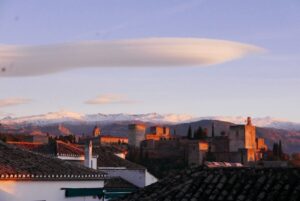
Generally speaking, accommodation in Spain is cheaper than in Germany. I paid €290 per month for a small but beautiful room in a shared house in the Albaicín, with a rooftop terrace and a view of the Alhambra and the Sierra Nevada. There were 18 international students living in the house, which may sound a bit overwhelming at first. For me, however, it was ideal, as I assumed it might be difficult to meet many people during such a short stay. My roommates were incredibly kind and quickly felt like a small family. Since some of them were Latin American and most had a good level of Spanish, we mainly spoke Spanish at home.
©International Office
I personally really enjoyed living in the Albaicín, as it is a very quiet neighbourhood with hardly any cars. However, you do have to walk up a fairly steep hill every day, which can be somewhat exhausting. On the other hand, this also allows you to enjoy a beautiful sunrise over the rooftops of Granada every morning on your way to the bus stop. Many Erasmus students also live in the city centre around the cathedral or near Camino de Ronda, where most bars and clubs are located.
Accommodation can mainly be found via Idealista. Many listings specify minimum rental periods, but I would still recommend asking, especially if you start your internship in the middle of the semester, as many rooms may still be available. Since contact is usually directly with the landlord (even for shared apartments) and scams are relatively common, I strongly recommend arranging at least a video call before making any payments—ideally also getting in touch with someone currently living in the apartment. The lead time before the start of the rental period is usually quite short; for example, I found my room just one week before my flight. Many people also choose to rent an Airbnb or stay in a hostel for the first week and look for accommodation after they arrive in Granada. During the winter months, I would definitely recommend renting a room with heating, as it can get quite cold in Granada and Spanish houses are generally not as well insulated as German ones. Supermarket and public transport prices are slightly cheaper than in Germany.
3. Everyday Life
Cycling in the city is not very common and seems rather dangerous, which is why I used the bus to get to the hospital. Since Granada is a very small city, most distances are walkable, and even the longest bus rides take no more than 20–30 minutes. As I was not enrolled at the University of Granada, I was not eligible for the student bus ticket, but a regular monthly ticket is available for around €30.

©International Office
As a medical student, you should be aware that in Spain it is very uncommon for students to be actively involved in clinical work, and internships are generally considered observational. In my case, the doctors were very friendly and eager to explain things, but I still missed being able to participate more actively and feeling like a real part of the team, as is often the case in Germany. During my two-month internship, I did not receive an access card to open doors (such as the entrance to the surgical area) or a code for the scrubs dispenser, which meant that I had to wait for and ask doctors every day to enter restricted areas and obtain my work clothes. Nevertheless, especially the residents treated me very kindly and included me in team activities, such as having a beer with the head of department after work, visiting the Alhambra, or attending their Christmas dinner.
Moreover, students are not really expected to stay at the hospital in the afternoons, and on most days, I was able to leave between 12 and 2 p.m. This left me with plenty of free time to explore Granada and work on my doctoral thesis. I would definitely recommend having a good level of Spanish. Even though some doctors speak English, most prefer Spanish and are clearly relieved when they realise that you speak it as well.
4. Free Time
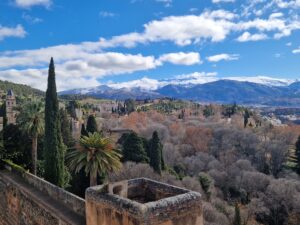
Granada is an ideal city for anyone interested in history, architecture, and culture. It represents a true melting pot of Arabic, North African, Spanish, and Gitano culture. Even though the city is not very large, it offers countless restaurants, clubs, and, of course, tapas bars, where drinks are still traditionally served with a free tapa. There are many remarkable places to visit, such as the Alhambra, but also the numerous cármenes and viewpoints in the Albaicín.
©International Office
Depending on the season, hiking, climbing (including via ferratas), and skiing are possible in the Sierra Nevada mountains, which can easily be reached by bus. I personally enjoy dancing salsa and was very happy to discover that Granada offers several dance schools and a number of social dance events each week. This is also a great way to connect with locals; for example, my class would often go out for drinks together after the lessons. Running and cycling can be somewhat challenging due to the city’s many hills and the lack of proper cycling lanes. Andalucía also offers many stunning cities that are well worth visiting, such as Málaga, Córdoba, Sevilla, and Cádiz. In summer, there are also several beach towns nearby that are ideal for short trips.
5. Conclusion
I would definitely recommend completing part of your practical year abroad, and especially in Granada. For me, it was the perfect city: small enough to quickly feel like home yet offering a great variety of activities and an incredible richness of culture and history. I had already completed an Erasmus semester in Málaga two years earlier and had fallen in love with Spanish culture, particularly Andalucía. But even if you are simply looking to escape the grey German winter, Granada is an ideal place to enjoy the afternoon sun on a rooftop terrace.
From a career perspective, however, the experience can be somewhat frustrating. Therefore, I would not recommend choosing a specialty you are seriously interested in or staying for longer than two months, unless you know in advance that the department allows students to actively participate. Since I did not have particularly high expectations and needed to work extensively on my doctoral thesis anyway, this did not bother me too much. Moreover, I am extremely grateful for this special time and for the friendships I made in Granada, and I would choose to do it the exact same way again.
My practical year in Montpellier
- Medicine
- France, Montpellier
- Centre Hospitalier Universitaire (CHU) de Montpellier
- 07/2024 – 10/2024
1. Application/Finding an Internship
From an early stage, it was clear to me that I wanted to complete a substantial part of my practical year, my medical internship, abroad. After planning my first rotation in Dubai and having my second in Germany, I wanted to see and experience something different for my third rotation. I chose to take another challenge: general surgery in Montpellier, Southern France. The application process was relatively straightforward; I sent an email to the head of the department in early 2024, and my application was quickly accepted. Further organization was handled through the universities in France and Germany. The process in France was similar to that in Germany, requiring vaccination records, certain health tests, and proof of insurance. Thanks to EU agreements, I didn’t have to worry about obtaining a visa.
Further planning included my travel arrangements and accommodation. I combined my journey with my family as a little road trip through Switzerland, Italy, and Monaco. For accommodation, I recommend student dormitories, but it is important to note that not all of them accept short-term stays, especially those that span multiple semesters. While I found it easy to secure accommodation for the semester holidays at the start of my internship, I had to move at the beginning of the new semester. Finding new accommodation was quite stressful and not easy, given my work routine and studies. However, in the end, everything worked out.
2. Accommodation & Living Expenses
During my internship, I opted for student housing, which offered a more affordable living option compared to private apartments. The costs for living in Montpellier were manageable, especially considering the financial support I received. I found that groceries were reasonably priced, but dining out could become expensive.
The student dormitories offered essential amenities, such as kitchen facilities, allowing me to cook my own meals, which helped keep my expenses down. While I didn’t strictly budget, I was mindful of my spending since I also wanted to indulge in the local cuisine and travel during my free time. Overall, Montpellier is a vibrant city, and the cost of living was reasonable for a student lifestyle.
3. Everyday Life/The Internship
On the first day of my internship, I registered at the medical faculty next to the hospital, where I enrolled alongside other Erasmus students. I then went directly to the General, Visceral, and Transplant Surgery department, known as “Chirurgie B.” The senior physician responsible for externes showed me around the unit and explained the processes. In France, medical students are referred to as “externes,” while resident doctors are called “internes,” which can be confusing at first, as “interns” in English usually refers to final-year medical students. Our team typically consisted of three German and two French students. The French externes usually rotate every few weeks, which allowed me to meet many different people.
Each week, we were assigned to a department, which could include the ward, the operating room, or outpatient clinics. Depending on our interests, we also had the opportunity to rotate through radiology, endoscopy, and anesthesia. Additionally, we had one to two on-call shifts each week (including weekends) for liver transplants. A typical day began with the morning handover from the night shift and a round of visits to all patients on both the general and intensive care wards. After the handover, everyone focused on their own tasks. Once a week, usually on Fridays, there were classes for students, often in the form of OSCE exercises. These sessions were highly educational, although the language barrier sometimes created a tense, exam-like environment. After the classes, the entire team would gather to review and discuss the surgical schedule for the upcoming week, deliberating on various cases. During these discussions, both attending and senior physicians often posed questions to both internes and externes. Additionally, once a month, the internes gave presentations, which were followed by the big weekly rounds.
The general ward was structured similarly to those in Germany, consisting of double and single rooms. The intensive care unit primarily had single rooms, and the operating rooms were comparably designed. Access to various areas of the hospital was secured with access codes. Both internes and externes had a dedicated room on the ward equipped with computers and lockers. All externes received a personal account for the duration of their stay to access computers and the hospital information system.
A particular highlight in Chirurgie B were the liver transplants. During the 24-hour on-call shifts, the ones on-call were responsible for these procedures and had to be prepared to stand in the operating room for about eight hours straight. There was also the opportunity to voluntarily participate in organ retrieval, which often involved traveling to different locations or even flying by private jet. On one occasion, we were escorted by the police, which felt like a movie and was incredibly exciting. The retrieval process is very moving and deeply impressive, as it represents the final and selfless act of brain-dead patients. After retrieval, the liver is transported in a cooled state and appears gray; however, after several hours of surgery and restoration of blood flow, it regains its dark red color. This moment is magical and makes all worries, back pain, and fatigue fade away.
One challenging aspect was the work environment in the department. There was often a tense atmosphere among the resident doctors, which sometimes affected us externes. This led to conflicts between internes and externes, causing misunderstandings with the attending physicians and resulting in stricter oversight. However, thanks to the camaraderie among the externes, this was manageable.
I also wanted to gain insight into neurosurgery, so I contacted the chief physician, who invited me to observe a particularly interesting procedure: an awake brain surgery. The patient underwent head surgery and was awakened for about an hour during the procedure with the assistance of neuropsychologists, who guided her to perform various tasks in order to minimize the risks associated with the surgery. Since I have a strong interest in neurosurgery, this was definitely one of my personal highlights at the clinic.
Despite the initial language barrier and different dialects, I quickly settled in and was able to learn a lot. I observed procedures that I had only previously studied in theory. The awake surgery and the liver transplants were undoubtedly extraordinary experiences that left a lasting impression on me. I would like to extend a special thank you to my colleagues, whose support made the stress of the internship much more bearable. Moreover, the opportunity to forge international connections and broaden my horizons was particularly valuable.
4. Free Time/Tips
From the beginning, I met many nice people. After work, we often arranged to meet for dinner, take weekend trips, go canoeing, or even play mini-golf together. A particularly memorable trip was to the lavender fields in Provence, which were breathtakingly beautiful. Watching the Euro football matches together was another unforgettable experience 4 especially the public viewing when France was playing, which created an incredible, lively atmosphere. We also went on trips with the Erasmus group, including horse riding in the Camargue, which was a unique way to explore the region. Numerous wonderful moments were created, and I have many pictures that I enjoy looking at repeatedly.
To pursue my passion for golf, I joined a golf club in Montpellier, where I regularly participated in courses. I met many other golfers, but since this was my last internship rotation, I also had to study for the third state exam, which meant sacrificing some of my free time. During this time, I discovered the university libraries, which I also liked.
The location of Montpellier allowed me to take many trips across Southern Europe. For example, I was able to meet friends in Barcelona or pick up my cousin from her language course in Nice. A particular highlight was our family reunion in Venice for my mother’s birthday, where family members from the USA, the Dominican Republic, and Germany came together. It was wonderful to see the surprised faces of my relatives when they saw us there.
Another delightful moment was when friends from Germany visited me, and we spent a wonderful week together. We explored the city, enjoyed the local cuisine, and shared many unforgettable moments.
On Sundays, I attended mass at various Catholic churches around the city, including the cathedral. Following the mass in French wasn9t always easy, but reading the liturgy beforehand in both German and French helped me follow along more easily and gain more from the sermon.
For my return journey, my family picked me up, and we drove back via Lourdes and Paris. The Rosary procession and the water ritual formed a meaningful and memorable conclusion to my internship.
5. Conclusion
In conclusion, I can confidently say that the last rotation of my internship abroad was a complete success. I learned not only a lot professionally and linguistically but also gained numerous experiences, impressions, and valuable contacts. Montpellier taught me so much, and this experience will stay with me forever. Therefore, I would like to sincerely thank the Erasmus+ internship program for their support, which, along with my family’s assistance, made this stay possible. If you have any further questions, I am happy to help. Thank you!
