

Schlagwort: ‘Spanien’
My Clinical Elective in Granada
- Medicine
- Spain, Granada
- Universidad de Granada
- 11/2025 – 01/2026
1. Finding an Internship

©International Office
Organising clinical rotations as a medical student in Spain can be quite challenging, as most Spanish hospitals only accept foreign students during the summer months, when Spanish students are on break. I tried to obtain a placement in Madrid and Valencia without success but eventually secured an internship in the Department of General Surgery at Hospital Clínico San Cecilio through a personal connection via my Spanish teacher in Germany. It can be difficult to reach the department secretary; however, if you are interested, you are welcome to contact me for the email address of the Head of General Surgery (louisa.wolters@gmail.com).
I would recommend organising the internship several months in advance, as Spanish hospital administration tends to respond more slowly, for example when it comes to signing the Learning Agreement for Traineeships. In addition, I had to register on an online platform (r0) of the University of Granada, for which an erweitertes Führungszeugnis (extended police clearance certificate) is required. Obtaining this document can take several weeks. Apart from that, the application for the Erasmus scholarship is very straightforward and quick. Since I split my practical year tertial and only completed a two-month internship, I did not have to enrol at the Spanish university.
2. Accommodation & Living Expenses
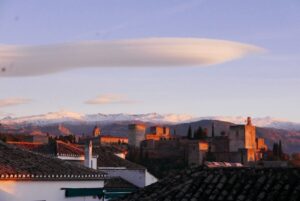
Generally speaking, accommodation in Spain is cheaper than in Germany. I paid €290 per month for a small but beautiful room in a shared house in the Albaicín, with a rooftop terrace and a view of the Alhambra and the Sierra Nevada. There were 18 international students living in the house, which may sound a bit overwhelming at first. For me, however, it was ideal, as I assumed it might be difficult to meet many people during such a short stay. My roommates were incredibly kind and quickly felt like a small family. Since some of them were Latin American and most had a good level of Spanish, we mainly spoke Spanish at home.
©International Office
I personally really enjoyed living in the Albaicín, as it is a very quiet neighbourhood with hardly any cars. However, you do have to walk up a fairly steep hill every day, which can be somewhat exhausting. On the other hand, this also allows you to enjoy a beautiful sunrise over the rooftops of Granada every morning on your way to the bus stop. Many Erasmus students also live in the city centre around the cathedral or near Camino de Ronda, where most bars and clubs are located.
Accommodation can mainly be found via Idealista. Many listings specify minimum rental periods, but I would still recommend asking, especially if you start your internship in the middle of the semester, as many rooms may still be available. Since contact is usually directly with the landlord (even for shared apartments) and scams are relatively common, I strongly recommend arranging at least a video call before making any payments—ideally also getting in touch with someone currently living in the apartment. The lead time before the start of the rental period is usually quite short; for example, I found my room just one week before my flight. Many people also choose to rent an Airbnb or stay in a hostel for the first week and look for accommodation after they arrive in Granada. During the winter months, I would definitely recommend renting a room with heating, as it can get quite cold in Granada and Spanish houses are generally not as well insulated as German ones. Supermarket and public transport prices are slightly cheaper than in Germany.
3. Everyday Life
Cycling in the city is not very common and seems rather dangerous, which is why I used the bus to get to the hospital. Since Granada is a very small city, most distances are walkable, and even the longest bus rides take no more than 20–30 minutes. As I was not enrolled at the University of Granada, I was not eligible for the student bus ticket, but a regular monthly ticket is available for around €30.

©International Office
As a medical student, you should be aware that in Spain it is very uncommon for students to be actively involved in clinical work, and internships are generally considered observational. In my case, the doctors were very friendly and eager to explain things, but I still missed being able to participate more actively and feeling like a real part of the team, as is often the case in Germany. During my two-month internship, I did not receive an access card to open doors (such as the entrance to the surgical area) or a code for the scrubs dispenser, which meant that I had to wait for and ask doctors every day to enter restricted areas and obtain my work clothes. Nevertheless, especially the residents treated me very kindly and included me in team activities, such as having a beer with the head of department after work, visiting the Alhambra, or attending their Christmas dinner.
Moreover, students are not really expected to stay at the hospital in the afternoons, and on most days, I was able to leave between 12 and 2 p.m. This left me with plenty of free time to explore Granada and work on my doctoral thesis. I would definitely recommend having a good level of Spanish. Even though some doctors speak English, most prefer Spanish and are clearly relieved when they realise that you speak it as well.
4. Free Time
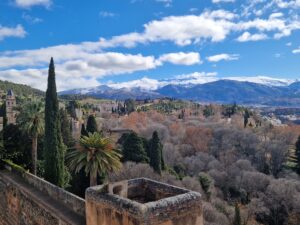
Granada is an ideal city for anyone interested in history, architecture, and culture. It represents a true melting pot of Arabic, North African, Spanish, and Gitano culture. Even though the city is not very large, it offers countless restaurants, clubs, and, of course, tapas bars, where drinks are still traditionally served with a free tapa. There are many remarkable places to visit, such as the Alhambra, but also the numerous cármenes and viewpoints in the Albaicín.
©International Office
Depending on the season, hiking, climbing (including via ferratas), and skiing are possible in the Sierra Nevada mountains, which can easily be reached by bus. I personally enjoy dancing salsa and was very happy to discover that Granada offers several dance schools and a number of social dance events each week. This is also a great way to connect with locals; for example, my class would often go out for drinks together after the lessons. Running and cycling can be somewhat challenging due to the city’s many hills and the lack of proper cycling lanes. Andalucía also offers many stunning cities that are well worth visiting, such as Málaga, Córdoba, Sevilla, and Cádiz. In summer, there are also several beach towns nearby that are ideal for short trips.
5. Conclusion
I would definitely recommend completing part of your practical year abroad, and especially in Granada. For me, it was the perfect city: small enough to quickly feel like home yet offering a great variety of activities and an incredible richness of culture and history. I had already completed an Erasmus semester in Málaga two years earlier and had fallen in love with Spanish culture, particularly Andalucía. But even if you are simply looking to escape the grey German winter, Granada is an ideal place to enjoy the afternoon sun on a rooftop terrace.
From a career perspective, however, the experience can be somewhat frustrating. Therefore, I would not recommend choosing a specialty you are seriously interested in or staying for longer than two months, unless you know in advance that the department allows students to actively participate. Since I did not have particularly high expectations and needed to work extensively on my doctoral thesis anyway, this did not bother me too much. Moreover, I am extremely grateful for this special time and for the friendships I made in Granada, and I would choose to do it the exact same way again.
My Erasmus Traineeship in Valladolid
- Medicine
- Spain, Valladolid
- Universidad de Valladolid
- 01/2024 – 06/2024
My name is Felix and I’m a medicine student from Aachen, Germany. This year I spent 6 month of my practical year taking part in a hospital Internship at the University of Valladolid in Spain.
Preparation
As for the preparation I first reached out about a year before my stay to the Erasmus coordinator and the dean of the Faculty of Medicine at the university. Although sometimes hard to reach, he will eventually answer you and help you with whatever request you might have. He recommended me to contact two other doctors to organise the different parts of my internship. Eventually I organized my stays with the respective heads of the different departments and presented my final rotation in internal medicine and surgery to these two doctors to get their confirmation.
Arrival and Organisation
I arrived 1 week prior to the start of my internship, which gave me time to visit the international office and organize the formalities. Although I could not be matriculated without taking any assignments, they were very helpful and worked out a way to provide me with the student badge. That way I could take part in the university sport and other programs, such as the GUM, which is a group of students and other people that go on hikes every 2nd Sunday throughout the entire year. In order to get set up for the hospital, I had to go to the Dean’s office, where the friendly employees helped me go through the process of registering for my internship, which included receiving my nametag and clothes for the hospital. For this process a “Certificado de los delitos sexuales” is necessary. This was very easy to get at the local state’s office. I got a date within 3 days and it only took them 1-2 days to get the necessary information from Germany and to send me the certificate via email. All in all the people were always very friendly and helpful which made the process easy, even though some things couldn’t be resolved right away.
Accommodation
Accommodations in Valladolid are surprisingly cheap and easy to find. Rooms in a shared flat generally range between 180 and 350€. Studios aren’t much more expensive either. The main website used is Idealista, but you can also find rooms through facebook (watch out for scammers). I wanted to get to know people which is why I was looking for a flatshare. After only about 3 days of search I found a very nice room in a central apartment right next to the main shopping street. Although not very good equipped and a bit lived through, the apartment was very nice and that way I got to know other international people. It is worth to mention that in Valladolid (and other Spanish cities from what I’ve heard) it’s common for landlords to take away money from your bond, or even the whole bond without indicating a reason. It seems to be a way of making extra money off international students, who usually can’t do much about it. After this happened to some of my roommates as well, I decided to not pay my last months rent and leave the bond to the landlord, which is a common strategy.
The City
Valladolid wouldn’t have been the city of my choice if it weren’t for my girlfriend, who is from there. My expectations weren’t very high, and got easily excelled by this mid-sized city in central Spain. It has a beautiful historic centre and even an artificial beach at the riverside. Located about 1 hour from Madrid by train and 2.5 hours from the north coast by car, the city is particularly well located in Spain. It gives you the possibility to regularly visit the capital or to rent a car for a cheap price and spend the weekend at the sea, surfing or enjoying the incredible nature of the north. What is more, it is surrounded by the beautiful and historic cities of Castilla y León, such as Salamanca, Segovia, Burgos and León, which are all worth a visit. Being the capital of its region is what makes Valladolid a very attractive city. While the weekdays are rather calm, on the weekends it attracts plenty of people from all around. This leads to the city offering a large variety of activities, sports, restaurants, bars and results in a high quality of living. The city hosts many events throughout the year, including regular and free public concerts on the Plaza Mayor, theatre and music festivals and the famous San Juan in June, where everyone goes to the beach to enjoy the longest night of the year at a bonfire. Valladolid also offers beautiful parks and an immense amount of terraces, where you can find some of the best and cheapest tapas in all of Spain. Drinks and food are extraordinarily cheap, which allows you to spend a big amount of your time outside, enjoying the Spanish way of living. Personally, I loved that it’s very easy to leave the city by bike or bus and be in the nature in the blink of an eye. It is also worth to mention, that the Spanish in Castilla y León is considered the clearest and easiest to understand in all of Spain.
The Hospital
I spent 2 months of my Internal Medicine internship at the Hospital Río Hortega and my 4 months of surgical internship at the Hospital Clínico. I can recommend both hospitals. While Río Hortega is a very modern and well equipped hospital located outside the city centre (12-15 minutes by bike), Clínico is located right in the heart of Valladolid, next to the Faculty of Medicine and has a nice and familiar touch to it. Generally it is important to say, that Spanish medicine students don’t get to participate in the daily hospital work near as much as German students. The working hours are from 8am to 3pm, but the doctors might leave earlier when the daily ward round and the examination of the patients are done. In Internal Medicine, the tasks are limited to following your assigned doctor and examining the patients. The doctors are generally very open and willing to explain you everything. There is no time pressure which leaves plenty of time to explain diseases and procedures. But the low patient flow also leads to a lower input compared to other countries. The emergency department was the only department where I got to assess my own patients and right down the anamnesis and reports before discussing the procedures with the doctors. In the surgery departments the Spanish students rarely take part in the surgeries. I was lucky to get to know a couple of doctors who would regularly let me take part in surgeries and perform assisting tasks like holding hooks, unscrewing screws or sew a few stitches. Although I definitely learned new things it was probably less compared to spending the same amount of time in a German hospital.
Conclusion
I had a great time throughout my stay in Valladolid and am very happy to have gotten to know the country, the city and the people. Valladolid is a beautiful city and has much more to offer than one would expect at first glance. It may not be able to compete with Spains major cities when it comes to the cultural offer and nightlife but impresses with a high quality of life, easy access to the nature and a cheap cost of living.
