
Categories
Pages
-
-

ROBOTIK UND MECHATRONIK

Schlagwort: ‘Additive Manufacturing’

Rethinking Additive Manufacturing: From Simulation to Robot-Assisted Implementation

April 15th, 2026 | by

Im Projekt FunkDAF arbeiten wir am IGMR gemeinsam mit dem Institut für Maschinenelemente und Systementwicklung (MSE) – RWTH Aachen und dem Visual Computing Institute daran, den gesamten Produktentwicklungsprozess in der additiven Fertigung ganzheitlich abzubilden – von der Bauteilgenerierung bis hin zur finalen Fertigung und Validierung.

Additive Fertigung neu gedacht: Von der Simulation zur robotergestützten Umsetzung

Der an dieser Stelle eingebundene Inhalt führt Sie auf Seiten, die von der von Google betriebenen Seite YouTube - YouTube, LLC, 901 Cherry Ave., San Bruno, CA 94066, USA - zur Verfügung gestellt werden. Mit dem Aufruf des Inhalts kann YouTube Ihre IP-Adresse und die Sprache des Systems, sowie verschiedene browserspezifische Angaben ermitteln. Wenn Sie in Ihrem YouTube-Account eingeloggt sind, ermöglichen Sie YouTube, Ihr Surfverhalten direkt Ihrem persönlichen Profil zuzuordnen. Dies können Sie verhindern, indem Sie sich aus Ihrem YouTube-Account ausloggen. YouTube verwendet Cookies und Tracking-Tools. Die Datenverarbeitungsvorgänge sowie die Zwecke der Verarbeitung können direkt bei YouTube erfragt und eingesehen werden.

At the MSE, load-bearing components are created using generative design and optimized for stress through FEM analyses. Building on this stress data, the VCI develops print path-oriented strategies that are specifically aligned with the principal stress directions. This reduces anisotropic effects in additively manufactured components, improves material utilization, and significantly increases component strength.

At the IGMR, we put these innovative print paths into practice: Using a robot-assisted setup—consisting of a moving print bed and a fixed extruder—the paths are first adjusted and then converted into precise robot trajectories. The manufactured components are finally subjected to mechanical testing to validate the underlying hypotheses.

Topologically optimized flexible 3D gripper

June 5th, 2025 | by

How can objects be gripped safely and gently at the same time – without any traditional joints?

With this 3D-printed prototype, we demonstrate how topological optimization and compliant mechanisms together open up new paths in robotic gripping.
The design is based on flexible structures that can be strongly deformed through targeted geometry adjustment – ideal for adapting to spherical objects, for example.

Objective:
– Maximization of the contact surfaces
– Even distribution of forces
– Reduction of damage to the object

Thanks to additive manufacturing and computer-aided design, complex, high-performance structures could be implemented that would be almost impossible to realize using conventional methods.

Contact person:
Estefania Hermoza Llanos


Multidirectional Additive Manufacturing

June 26th, 2020 | by

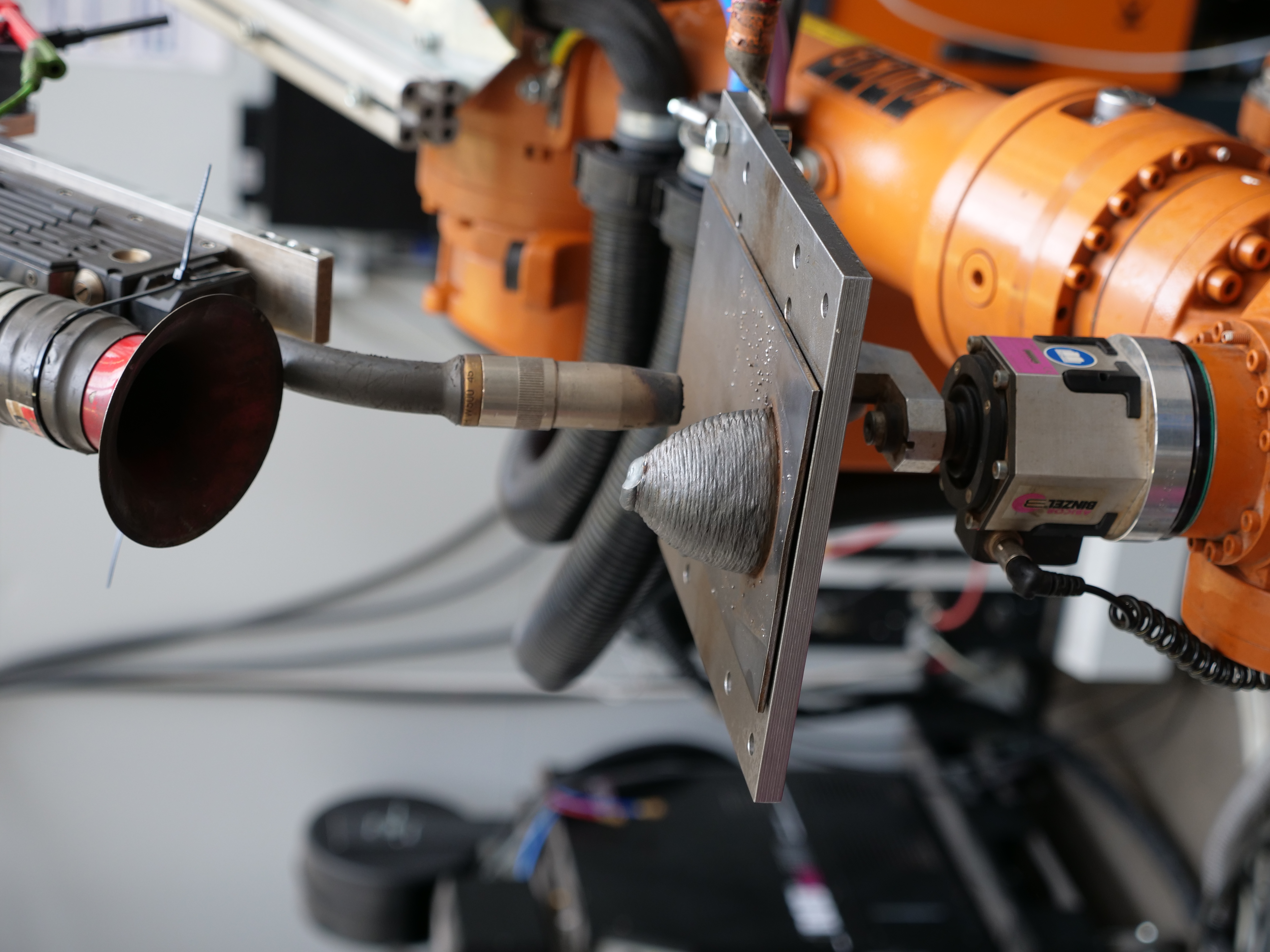
In the new DFG project, components are manufactured with robots using wire arc additive manufacturing. Multidirectionality is to be exploited in the process.

Contact:

Markus Schmitz