Kategorie: ‘C++’
Collision-free trajectory planning for growing components in robot-assisted manufacturing

Der an dieser Stelle eingebundene Inhalt führt Sie auf Seiten, die von der von Google betriebenen Seite YouTube - YouTube, LLC, 901 Cherry Ave., San Bruno, CA 94066, USA - zur Verfügung gestellt werden. Mit dem Aufruf des Inhalts kann YouTube Ihre IP-Adresse und die Sprache des Systems, sowie verschiedene browserspezifische Angaben ermitteln. Wenn Sie in Ihrem YouTube-Account eingeloggt sind, ermöglichen Sie YouTube, Ihr Surfverhalten direkt Ihrem persönlichen Profil zuzuordnen. Dies können Sie verhindern, indem Sie sich aus Ihrem YouTube-Account ausloggen. YouTube verwendet Cookies und Tracking-Tools. Die Datenverarbeitungsvorgänge sowie die Zwecke der Verarbeitung können direkt bei YouTube erfragt und eingesehen werden.
As part of the FunkDAF research project, the IGMR is working with the MSE and VCI at RWTH Aachen University to explore the limits of additive manufacturing. Our focus is on multidirectional manufacturing: instead of breaking down components into planar layers as in conventional 3D printing, we generate print paths based on stress data to create load-path-compatible and thus more stable structures.
The kinematics: We use a 6-axis industrial robot in a “robot-guided” configuration. The robot guides the print bed and component under a stationary extruder. This use of all six degrees of freedom enables the printing of complex, non-planar geometries and allows component sections to be manufactured in variable orientations to gravity.
The challenge: Trajectory planning for such systems is highly complex. Unlike static print beds, we are moving a dynamically growing workpiece in space. During the process, the component itself becomes a potential collision object with respect to the nozzle and the environment. To make matters more difficult, the extrusion process requires a minimum working distance from the stationary nozzle. Path planning must therefore not only take extrusion into account, but also precisely calculate how the component volume changes.
The travel paths (empty runs) between individual printing segments are particularly critical. Here, the robot often has to completely reorient the component in order to reach the next section without collision. Our current experiments (see images) demonstrate this impressively:
Helix on cylinder: Requires continuous, coordinated rotation to deposit material on a curved surface.
Orthogonal cuboids: Demonstrate the ability to print overhangs without support structures through a 90° reorientation.
Contact person: Mark Witte
Further information about the project can be found here.
Semi-Automated Tile-Laying Aid

Der an dieser Stelle eingebundene Inhalt führt Sie auf Seiten, die von der von Google betriebenen Seite YouTube - YouTube, LLC, 901 Cherry Ave., San Bruno, CA 94066, USA - zur Verfügung gestellt werden. Mit dem Aufruf des Inhalts kann YouTube Ihre IP-Adresse und die Sprache des Systems, sowie verschiedene browserspezifische Angaben ermitteln. Wenn Sie in Ihrem YouTube-Account eingeloggt sind, ermöglichen Sie YouTube, Ihr Surfverhalten direkt Ihrem persönlichen Profil zuzuordnen. Dies können Sie verhindern, indem Sie sich aus Ihrem YouTube-Account ausloggen. YouTube verwendet Cookies und Tracking-Tools. Die Datenverarbeitungsvorgänge sowie die Zwecke der Verarbeitung können direkt bei YouTube erfragt und eingesehen werden.
As part of the ErgoFli project, an innovative system is being developed in collaboration with project partners to help tile layers make their work more ergonomic and efficient.
In the video you can see how the system works in the Gazebo simulation environment. The robot automatically removes tiles from a magazine and matches them perfectly to the tiles already laid. With automatic processes, several tiles can be laid in succession to optimize the work process.
Our aim is to create a tool that not only reduces the workload for tilers, but also improves their working environment. We are excited about the progress and look forward to sharing more insights with you soon!
Find out more about the project here.
Contact person:
Mark Witte
Jan Wiartalla
IMBA training for the IIDEA project team
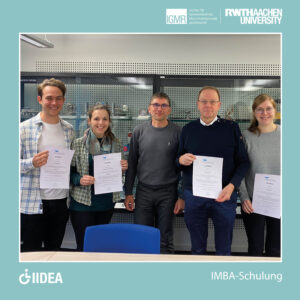
Our IIDEA-project team took part in a training course on the “Integration of people with disabilities into the world of work” (IMBA).
IMBA is positioned at the interface of medical and occupational rehabilitation and enables a precise description and comparison of work requirements and human abilities. The training covered the basics of IMBA, with a particular focus on the defined characteristics that serve as the basis for the assessment of work requirements and abilities. A highlight of the training was the introduction to the “Marie Plus” software, which is closely linked to the IMBA concept. The training was conducted by Torsten Alles, Ph.D., Managing Director of iqpr. His extensive knowledge and experience helped to emphasize the importance of IMBA in occupational therapy and activity-based medical rehabilitation.
We are convinced that this training will support our previous research and make a valuable contribution to the IIDEA project. We are grateful for the expertise we have gained through this training and look forward to applying the acquired knowledge in our daily work.
contact person:
Mathias Hüsing
Carlo Weidemann
Elodie Hüsing
Sophie-Charlotte Keunecke
Christina Jansen
Participation at European Robotics Forum (ERF) Hackathon 2022
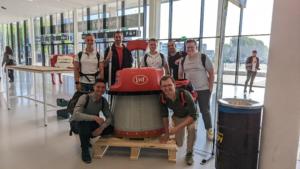
As part of the European Robotics Forum (ERF) Hackathon 2022, six IGMR students demonstrated their talent in prototyping and working with robots. The hackathon challenge was set by Lely, among others. Their ‘Juno‘ mobile robots are autonomous cylindrical platforms whose main task is to move the fencing around cows on farms to make the feed pushed into the space accessible again. The hackathon task was similar: two Juno robots had to move along the walls of two interconnected rooms at a given distance. Additional restrictions and challenges were added for extra points. The team was successful at the hackathon in Rotterdam. After a neck-and-neck race, the first place went to TU Delft. At the award ceremony, we were praised as the most cooperative team for our “constant support of other teams in design and 3D printing“. This ‘exemplary behaviour‘ is much appreciated and we look forward to taking part again next year.
Special praise goes to our students Sebastian Polzin, Frederik van Kerkom, Jonas Braun, Oleksander Kutovyi, Ali Berger and Yannik Freischlad for their efforts. We congratulate TU Delft on their well-deserved victory and are happy to have won many new friends and valuable contacts. We thank the institute management for the opportunity to participate and look forward to next year.
Contact:
Integrated AI task planning and screw recognition in a production scenario

Der an dieser Stelle eingebundene Inhalt führt Sie auf Seiten, die von der von Google betriebenen Seite YouTube - YouTube, LLC, 901 Cherry Ave., San Bruno, CA 94066, USA - zur Verfügung gestellt werden. Mit dem Aufruf des Inhalts kann YouTube Ihre IP-Adresse und die Sprache des Systems, sowie verschiedene browserspezifische Angaben ermitteln. Wenn Sie in Ihrem YouTube-Account eingeloggt sind, ermöglichen Sie YouTube, Ihr Surfverhalten direkt Ihrem persönlichen Profil zuzuordnen. Dies können Sie verhindern, indem Sie sich aus Ihrem YouTube-Account ausloggen. YouTube verwendet Cookies und Tracking-Tools. Die Datenverarbeitungsvorgänge sowie die Zwecke der Verarbeitung können direkt bei YouTube erfragt und eingesehen werden.
The video is also available on our YouTube channel.
Contact:
Daniel Gossen
Manipulator-specific path planning for multidirectional additive manufacturing
In a joint research project between the IGMR and the ISF of RWTH Aachen University, research is being conducted on the Multidirectional Additive Manufacturing of metallic components.
With the aid of Multidirectional Additive Manufacturing (MDAM), it is possible to build complex components layer by layer and without the need for support structures. By moving the base plate by means of an industrial robot while the welding gun remains fixed, the component to be printed can always be oriented in such a way that support structures can be avoided. The major challenge lies in the consideration of specialized welding processes with external wire feeding and the use of sensors for process monitoring. This results in a dependency of the orientation of the welding gun compared to the currently printed path.
As part of his master’s thesis, Jan Wiartalla developed a path planning algorithm that calculates an executable and, if possible, continuous path within specified, flat part slices that completely fills the cross-sectional area. This is done robot-specific, so that the algorithm always takes the robot currently in use as well as its limitations into account. A standardized interface allows for the robot model to be easily exchanged and the algorithm can thus quickly be adapted to different test environments. The video illustrates the algorithm’s procedure in a simplified way.
https://youtu.be/chuD57ja9JE
Contacts:


