Kategorie: ‘Trajektorie’
Collision-free trajectory planning for growing components in robot-assisted manufacturing

Der an dieser Stelle eingebundene Inhalt führt Sie auf Seiten, die von der von Google betriebenen Seite YouTube - YouTube, LLC, 901 Cherry Ave., San Bruno, CA 94066, USA - zur Verfügung gestellt werden. Mit dem Aufruf des Inhalts kann YouTube Ihre IP-Adresse und die Sprache des Systems, sowie verschiedene browserspezifische Angaben ermitteln. Wenn Sie in Ihrem YouTube-Account eingeloggt sind, ermöglichen Sie YouTube, Ihr Surfverhalten direkt Ihrem persönlichen Profil zuzuordnen. Dies können Sie verhindern, indem Sie sich aus Ihrem YouTube-Account ausloggen. YouTube verwendet Cookies und Tracking-Tools. Die Datenverarbeitungsvorgänge sowie die Zwecke der Verarbeitung können direkt bei YouTube erfragt und eingesehen werden.
As part of the FunkDAF research project, the IGMR is working with the MSE and VCI at RWTH Aachen University to explore the limits of additive manufacturing. Our focus is on multidirectional manufacturing: instead of breaking down components into planar layers as in conventional 3D printing, we generate print paths based on stress data to create load-path-compatible and thus more stable structures.
The kinematics: We use a 6-axis industrial robot in a “robot-guided” configuration. The robot guides the print bed and component under a stationary extruder. This use of all six degrees of freedom enables the printing of complex, non-planar geometries and allows component sections to be manufactured in variable orientations to gravity.
The challenge: Trajectory planning for such systems is highly complex. Unlike static print beds, we are moving a dynamically growing workpiece in space. During the process, the component itself becomes a potential collision object with respect to the nozzle and the environment. To make matters more difficult, the extrusion process requires a minimum working distance from the stationary nozzle. Path planning must therefore not only take extrusion into account, but also precisely calculate how the component volume changes.
The travel paths (empty runs) between individual printing segments are particularly critical. Here, the robot often has to completely reorient the component in order to reach the next section without collision. Our current experiments (see images) demonstrate this impressively:
Helix on cylinder: Requires continuous, coordinated rotation to deposit material on a curved surface.
Orthogonal cuboids: Demonstrate the ability to print overhangs without support structures through a 90° reorientation.
Contact person: Mark Witte
Further information about the project can be found here.
Optimal Control to Suppress Vibrations

Der an dieser Stelle eingebundene Inhalt führt Sie auf Seiten, die von der von Google betriebenen Seite YouTube - YouTube, LLC, 901 Cherry Ave., San Bruno, CA 94066, USA - zur Verfügung gestellt werden. Mit dem Aufruf des Inhalts kann YouTube Ihre IP-Adresse und die Sprache des Systems, sowie verschiedene browserspezifische Angaben ermitteln. Wenn Sie in Ihrem YouTube-Account eingeloggt sind, ermöglichen Sie YouTube, Ihr Surfverhalten direkt Ihrem persönlichen Profil zuzuordnen. Dies können Sie verhindern, indem Sie sich aus Ihrem YouTube-Account ausloggen. YouTube verwendet Cookies und Tracking-Tools. Die Datenverarbeitungsvorgänge sowie die Zwecke der Verarbeitung können direkt bei YouTube erfragt und eingesehen werden.
In pick-and-place tasks, which are often implemented with delta robots in industrial practice, short cycle times are desired. These lead to high accelerations of the robot and thus to high inertial forces, which cause the frame to vibrate. The frame vibrations reduce the performance and positioning accuracy of the robot and lead to material fatigue. To reduce frame vibrations, we have developed an optimal control approach that calculates vibration-reducing trajectories. To reduce vibrations, the free frame vibration is suppressed at the end of the trajectory. The chosen approach optimizes the trajectory holistically, i.e., both the geometric path and the motion law along the path are optimized. The optimization uses a multibody simulation model that was constructed with the aid of experimental system identification. Application- and robot-specific boundary conditions can be taken into account in the calculation of vibration-reducing trajectories.
contact:
Nils Brückmann
Christian Mirz
Preprint of the corresponding paper can be found here.
Further information on the Delta robot can be found here.
FunkDAF: Multidimensional additive manufacturing
At the IGMR, we are working on the next generation of additive manufacturing as part of the DFG-funded FunkDAF research project together with the MSE and VCI institutes: layerless, multidimensional material deposition.
🔹 What does that mean?
Multiaxial additive manufacturing with a robot-guided print bed allows us to deposit material along specific stress paths. This leads to improved material utilization and reduces the disadvantages of layer-by-layer construction.
🔹 Our challenges:
– Precise robot guidance along the print paths
– Synchronization of extruder and robot movement
– Constant printing speed for maximum quality
The print paths are generated on the VCI from FEM stress data – resulting in mechanically optimized structures. 💡
Contact person:
Mark Witte – witte@igmr.rwth-aachen.de
IMBA training for the IIDEA project team
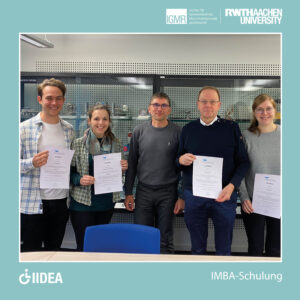
Our IIDEA-project team took part in a training course on the “Integration of people with disabilities into the world of work” (IMBA).
IMBA is positioned at the interface of medical and occupational rehabilitation and enables a precise description and comparison of work requirements and human abilities. The training covered the basics of IMBA, with a particular focus on the defined characteristics that serve as the basis for the assessment of work requirements and abilities. A highlight of the training was the introduction to the “Marie Plus” software, which is closely linked to the IMBA concept. The training was conducted by Torsten Alles, Ph.D., Managing Director of iqpr. His extensive knowledge and experience helped to emphasize the importance of IMBA in occupational therapy and activity-based medical rehabilitation.
We are convinced that this training will support our previous research and make a valuable contribution to the IIDEA project. We are grateful for the expertise we have gained through this training and look forward to applying the acquired knowledge in our daily work.
contact person:
Mathias Hüsing
Carlo Weidemann
Elodie Hüsing
Sophie-Charlotte Keunecke
Christina Jansen
New research topic at IGMR: Pick & Toss
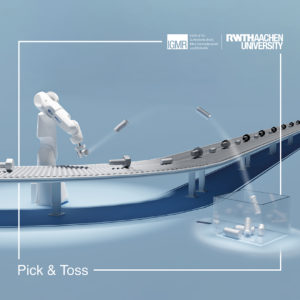
Today’s production plants would be unthinkable without robotic pick & place processes. Handling objects are picked by the robot and placed at the target position with the desired target orientation. An innovative possibility to significantly increase the workspace of a robot and to reduce process times is the extension of this process by the targeted throwing of handling objects. Possible areas of application are the sorting of products that are not damaged during the throwing process (e.g. screws or nuts) or whose damage is of secondary relevance (e.g. sorting out defective products, separating materials in recycling plants).
Our goal is to describe the robotic pick & toss process using a combination of classical analytical and machine learning models to make the innovative process industrially viable.
Contacts:
Nils Brückmann
Johannes Bolk
Cross section group: Application Dynamics
The Application Dynamics team is made up of members from all IGMR research areas. This allows the skills in vibration analysis and machine dynamics to be optimally combined with the expertise and many years of experience in power transmission and robotics. This fusion of the Institute’s internal research priorities enables solutions to be found to problems that require both technical knowledge of dynamics and application-specific expertise. This cross section of knowledge is applied, for example, in the form of a needs-based investigation and exploitation of the dynamic effects of a system. The focus is on applications in robotics and gearing, but also covers all types of mechanical motion systems. The current research horizon ranges from kinematic redundancy and high-speed trajectories to the use of neural networks to extend the workspace through innovative object manipulation.
Contact: Johannes Bolk
Integrated AI task planning and screw recognition in a production scenario

Der an dieser Stelle eingebundene Inhalt führt Sie auf Seiten, die von der von Google betriebenen Seite YouTube - YouTube, LLC, 901 Cherry Ave., San Bruno, CA 94066, USA - zur Verfügung gestellt werden. Mit dem Aufruf des Inhalts kann YouTube Ihre IP-Adresse und die Sprache des Systems, sowie verschiedene browserspezifische Angaben ermitteln. Wenn Sie in Ihrem YouTube-Account eingeloggt sind, ermöglichen Sie YouTube, Ihr Surfverhalten direkt Ihrem persönlichen Profil zuzuordnen. Dies können Sie verhindern, indem Sie sich aus Ihrem YouTube-Account ausloggen. YouTube verwendet Cookies und Tracking-Tools. Die Datenverarbeitungsvorgänge sowie die Zwecke der Verarbeitung können direkt bei YouTube erfragt und eingesehen werden.
The video is also available on our YouTube channel.
Contact:
Daniel Gossen
Multidirectional additive manufacturing in arc welding process
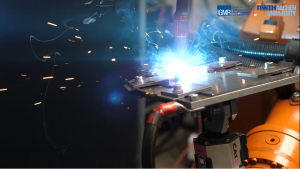
In collaboration with the ISF, RWTH Aachen, we at IGMR are researching Multidirectional Additive Manufacturing. In this application for the production of metal components.
Multidirectional Additive Manufacturing enables the production of complex components without support structures, both in the classic FDM process with plastic and with layer-by-layer buildup in the arc welding process. At IGMR, the entire process chain of additive manufacturing is being extended to meet the special challenges of this process from a robotic perspective. This includes the slicing of a virtual component into layers, the subsequent planning of a collision-free structure, the generation of executable robot paths for filling the layers as well as the necessary trajectory planning.
The content embedded at this point takes you to pages provided by the YouTube site operated by Google – YouTube, LLC, 901 Cherry Ave, San Bruno, CA 94066, USA. By calling up the content, YouTube can determine your IP address and the language of the system, as well as various browser-specific details. If you are logged into your YouTube account, you enable YouTube to assign your surfing behavior directly to your personal profile. You can prevent this by logging out of your YouTube account. YouTube uses cookies and tracking tools. The data processing operations as well as the purposes of the processing can be requested and viewed directly at YouTube.
Contact person:
Markus Schmitz
Carlo Weidemann
https://youtu.be/vYejNjBSUp8


