
Schlagwort: ‘Parameteridentifikation’
Optimalsteuerung zur Schwingungsunterdrückung

Der an dieser Stelle eingebundene Inhalt führt Sie auf Seiten, die von der von Google betriebenen Seite YouTube - YouTube, LLC, 901 Cherry Ave., San Bruno, CA 94066, USA - zur Verfügung gestellt werden. Mit dem Aufruf des Inhalts kann YouTube Ihre IP-Adresse und die Sprache des Systems, sowie verschiedene browserspezifische Angaben ermitteln. Wenn Sie in Ihrem YouTube-Account eingeloggt sind, ermöglichen Sie YouTube, Ihr Surfverhalten direkt Ihrem persönlichen Profil zuzuordnen. Dies können Sie verhindern, indem Sie sich aus Ihrem YouTube-Account ausloggen. YouTube verwendet Cookies und Tracking-Tools. Die Datenverarbeitungsvorgänge sowie die Zwecke der Verarbeitung können direkt bei YouTube erfragt und eingesehen werden.
In Pick and Place Aufgaben, welche in der industriellen Praxis häufig mit Delta Robotern umgesetzt werden, werden kurze Zykluszeiten angestrebt. Diese führen zu hohen Beschleunigungen des Roboters und somit zu hohen Trägheitskräften, welche das Gestell zu Schwingungen anregen. Die Gestellschwingungen reduzieren die Performance und die Positioniergenauigkeit des Roboters und führen zu Materialermüdung. Um die Gestellschwingungen zu reduzieren, haben wir einen Optimalsteuerungsansatz entwickelt, der schwingungsreduzierende Trajektorien berechnet. Zur Schwingungsreduktion wird hierbei die freie Gestellschwingung nach Trajektorienende unterdrückt. Der gewählte Ansatz optimiert die Trajektorie ganzheitlich, d.h. es werden sowohl der geometrische Pfad als auch das Bewegungsgesetz entlang des Pfades optimiert. Die Optimierung nutzt ein Mehrkörpersimulationsmodell, welches mithilfe einer experimentellen Systemidentifikation aufgebaut wurde. Anwendungs- und roboterspezifische Randbedingungen können bei der Berechnung schwingungsreduzierende Trajektorien berücksichtigt werden.
Ansprechpartner:
Nils Brückmann
Christian Mirz
Preprint des zugehörigen Papers finden Sie hier.
Weitere Informationen zum Delta Roboter finden Sie hier.
Neues Forschungsthema am IGMR: Pick & Toss
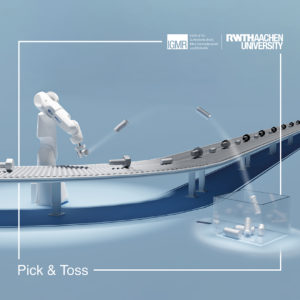
In heutigen Produktionsanlagen sind robotische Pick & Place Prozesse nicht mehr wegzudenken. Hierbei werden Handhabungsobjekte vom Roboter gegriffen und an der Zielposition mit der angestrebten Zielorientierung abgelegt. Eine innovative Möglichkeit den Arbeitsraum eines Roboters signifikant zu vergrößern sowie Prozesszeiten zu verringern ist die Erweiterung dieses Prozesses um das gezielte Werfen von Handhabungsobjekten. Mögliche Einsatzgebiete sind die Sortierung von Produkten, die beim Wurf nicht beschädigt werden (z.B. Schrauben oder Muttern) oder deren Beschädigung untergeordnet relevant ist (z.B. Aussortieren fehlerhafter Produkte, Trennen von Werkstoffen in Recyclingstätten).
Unser Ziel ist es den robotischen Pick & Toss Prozess durch die Kombination von klassisch analytischen und machine learning Modellen zu beschreiben, sodass der innovative Prozess industriell nutzbar wird.
Ansprechpartner:
Nils Brückmann
Johannes Bolk
Querschnittsgruppe: Application Dynamics
Das Team hinter Application Dynamics setzt sich aus allen Forschungsbereichen des IGMR zusammen. Auf diese Weise können die Fähigkeiten auf dem Gebiet der Schwingungsanalyse und Maschinendynamik optimal mit den Kompetenzen und langjährigen Erfahrungen rund um die Themen der Getriebetechnik und Robotik verein werden. Dieser Zusammenschluss Instituts interner Forschungsschwerpunkte, ermöglicht Problemlösungen in denen sowohl fachliche Kompetenzen der Dynamik als auch anwendungsspezifisches Fachwissen gefragt sind. Angewendet wird dieser Wissensquerschnitt beispielsweise in Form einer anforderungsbasierten Untersuchung und Ausnutzung der dynamischen Effekte eines Systems. Der Fokus liegt auf Anwendungen aus dem Bereich der Robotik und Getriebetechnik, erfasst darüber hinaus jedoch jegliche Arten mechanischer Bewegungseinrichtungen. Der aktuelle Forschungshorizont erstreckt sich von kinematischer Redundanz über high Speed Trajektorien bis hin zur Nutzung neuronaler Netze, mit welchen eine Erweiterung des Arbeitsraumes durch innovative Objektmanipulation erreicht wird.
Ansprechpartner: Johannes Bolk
IGMR Seminar 01. Februar 2021 14:30 Uhr: Veronika Zumpe, Kuka AG
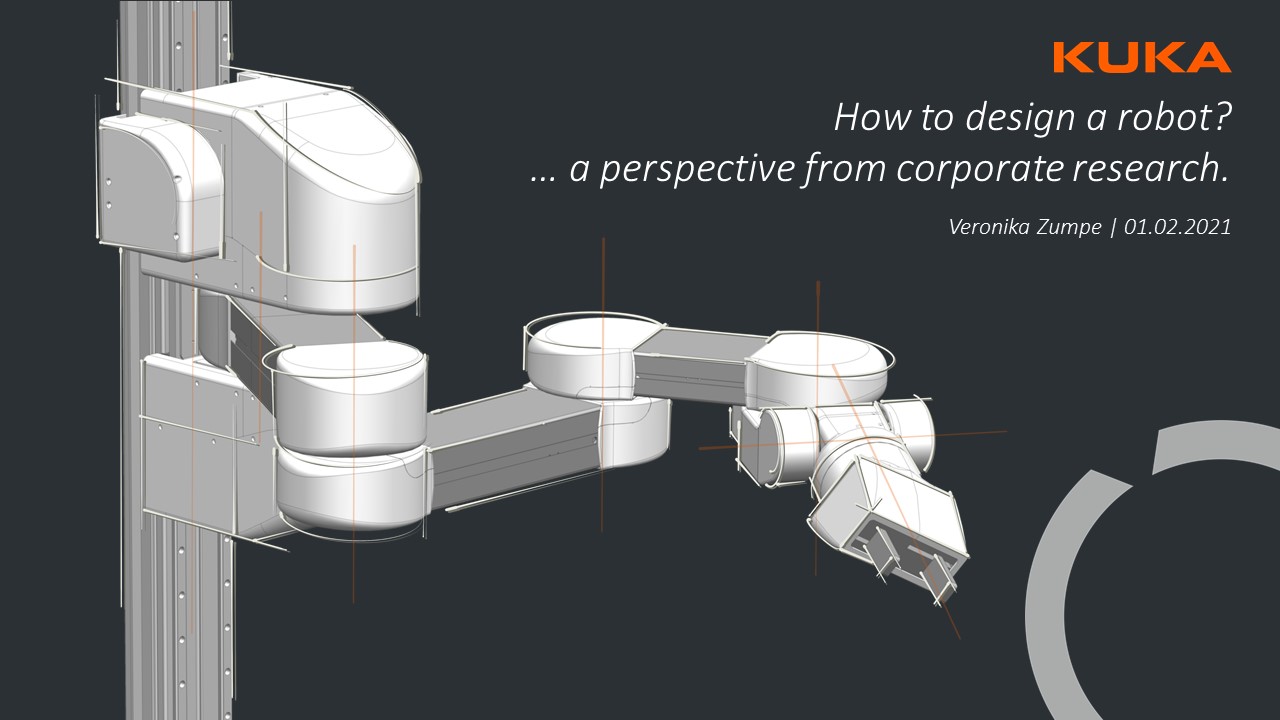
Wir begrüßen Frau Veronika Zumpe von Kuka zum IGMR Seminar. Auch dieser Veranstaltung wird weiterhin virtuell durchgeführt:
How to design a robot. A perspective from corporate research.
For specific handling tasks, there is a need for the development of new robotic systems. It is necessary to develop and design the system with respect to the given task, environment and other constraints. The design process includes finding a suitable kinematic, developing drive concepts for the robot axes, designing the structural parts and finalizing the robot design. For applications with human robot collaboration, more aspects like lightweight design play a significant role and thus should be taken into account. This talk gives a rough overview of the design process of a robot from my corporate research perspective.
Montag, 01. Februar 2021 14:30 Uhr in Zoom
https://rwth.zoom.us/j/98454895570?pwd=NkpiSWkyaTJtdWlralJrSUtnMDdDZz09
Meeting-ID: 984 5489 5570
Kenncode: 186393
Die Datenschutzhinweise zur Nutzung von Zoom und eine Handreichung für Teilnehmer (Studierende) können von den Seiten des CLS der RWTH Aachen University heruntergeladen werden.
Die Veranstaltungen im Wintersemester 2020/2021 werden in Zusammenarbeit mit dem VDI-GPP-Arbeitskreis des Bezirksvereins Aachen durchgeführt.
Ansprechpartner:


